Effective Note-Making Techniques for IELTS Listening
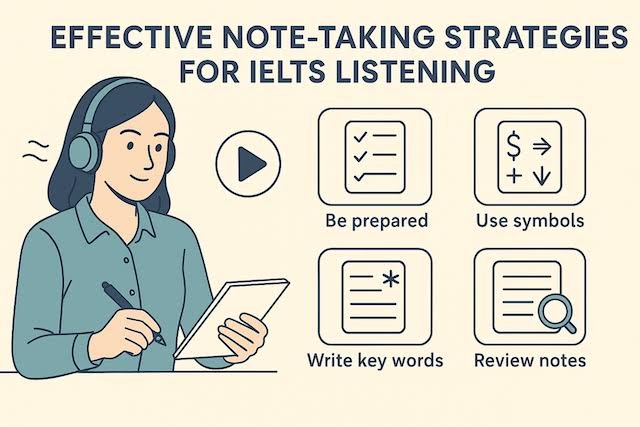
One of the most essential parts of the IELTS examination is the Listening part. This section of the test measures a candidate’s ability to understand spoken English in several settings. It may be a challenging part due to the one-time playback of the audio recordings, where important details can easily be missed by the candidate. Efficient techniques in taking notes will be very helpful in improving the band score of the candidate.
It should be noted that taking notes does not mean writing everything on the tape. Note-taking includes efficiently collecting important details. Practice in this particular aspect of testing will enable candidates to focus well during the test.
Join the Best IELTS coaching. Their expert faculty will provide you with guidance throughout your preparation journey and will help you achieve your desired band scores.
Effective note-making techniques for IELTS listening
Understand the IELTS listening format
Students have to be knowledgeable about the structure of the IELTS Listening test prior to learning about the ways of note-taking. There are usually four parts in the test, involving lectures, dialogues, and conversations. From one part to another, the level of difficulty gradually increases.
The candidates should listen carefully and answer questions regarding:
- Multiple Choice
- Form completion
- Sentence completion
- Labeling diagrams or maps
- Matching information
- Short answer questions
It is easier for students to guess what type of information they would require during their listening session if they know the structure of the test.
Use abbreviations and symbols
Symbols and acronyms are very effective time savers during listening exercises. Students need to come up with easy symbols for commonly used words.
For example:
- Information = information.
- Govt = government
- Dept = Department
- Std = student
- → = leads to
- ↑ = increase
- ↓ = decrease
Students will be able to write notes fast without losing track of what is being spoken.
Improve active listening skills
Complete attention to the speaker’s language, tone, and ideas can be referred to as active listening. It would be best if students stayed away from all passive listening skills and focused attentively on essential details, arguments, and shifts.
During the process of dictation, the speaker can modify some dates or correct his statements. A speaker could mention one date in his speech and then switch to another. It is necessary to identify the last one in order to give the right answer.
Active listening practice may include listening to different audiobooks, radio discussions, English broadcasts, etc.
Predict information before listening
Students normally have some time before the audio begins to go through the questions. This is an essential stage for preparation. Students must know how to quickly identify keywords and predict the kind of answer that would fit.
For example:
- Numbers are signified by a blank after “phone number.”
- Location/Street name is suggested by a blank after “address.”
- Money/Figures are signified by a blank after “price.”
It is easier for students to focus on certain information when they predict.
Organize notes clearly
Good notes will help one understand their responses easily. The students should ensure that they write neatly and use bullet points and other forms of notes, especially where necessary.
The students will be able to locate their responses easily without getting lost. They are likely to perform much better regardless of the time constraints they have.
Practice listening to different accents
The IELTS Listening Test contains accents like British, American, Australian, and Canadian accents. For example, during the test, those students concentrating on a particular accent would face difficulties due to the presence of accents that they had not heard before. To prepare for this test, it is very important to adapt to accents. Getting accustomed to different accents is helpful for improving your ability to listen and write down information. One can adapt to accents through watching English films, listening to podcasts, and watching shows.
Learn to ignore unnecessary information
However, not all words used in the recording have significance. Due to their efforts to include everything, most students get confused. The ability to distinguish the relevant information from the unnecessary information is one of the skills in effective note-taking.
The students should mainly focus on those aspects pertaining to the questions. This process will increase the speed during the exam.
Practice regularly with timed exercises
It requires practice to become good at note-taking. IELTS needs to be done by students. For increasing speed and concentration, students must attempt timed listening tests.
Candidates need to review their notes after practicing and identify mistakes, such as:
- Missed keywords
- Mistaken spellings
- Slow writing speed
- Lack of planning
Students who practice regularly will do well on the actual exam.
Are you an aspirant preparing for the PTE exam? If so, then join the Best PTE Institute to prepare under the expert guidance.
Conclusion
Getting marks on the IELTS Listening test needs good note-taking. To get faster and better at taking notes in the exam, you should focus on keywords. Use forms of words, listen carefully, and organize your notes well. Also, work on your vocabulary. Practice with accents and do timed exercises. This will make you more confident and improve your listening skills. You should be able to write down all the information quickly. Don’t try to write down everything. Good note-taking methods will improve your IELTS Listening results. They will help you get the band mark you want.


Post Comment