What to Look for When Choosing a free stock data api
Financial markets generate a huge amount of information every day. Stock prices change, companies release news, trading activity increases or decreases, and economic events can influence investor sentiment. For businesses, developers, investors, and researchers, having access to reliable market information can make financial research and application development easier.
A free stock data api can provide an affordable starting point for accessing stock market information. It can help developers build stock tracking applications, financial dashboards, research tools, educational platforms, and other projects. However, choosing an API should not be based only on the fact that it is free.
Different providers can offer different levels of data coverage, update frequency, request limits, documentation, and features. Understanding these factors can help businesses and developers choose an API that fits their requirements.
A stock exchange data api can also be useful when a project requires information from specific markets or exchanges. Before selecting a provider, it is important to understand what the API offers and whether it can support the project’s current and future needs.
Understand Your Data Requirements
Before comparing different APIs, start by identifying what your project actually needs.
Identify the Type of Market Data
Different applications require different types of information. A simple stock tracker may only need current price information, while an advanced research platform may require historical prices, market statistics, company information, and other financial data.
Make a list of the data your application needs. This will make it easier to compare providers and avoid choosing a service with unnecessary features.
Decide Whether You Need Real-Time Data
One of the most important questions is whether your project requires real-time market information.
Some applications may need frequently updated prices, while others may only need historical data for research or educational purposes. APIs can differ significantly in how often their information is updated.
Before choosing a service, check whether its data is real-time, delayed, or historical.
Check Stock Market Coverage
Market coverage is another important factor when choosing a free stock data api.
Look at Supported Exchanges
If your application focuses on specific markets, make sure the API provides the required exchange coverage.
A stock exchange data api may support certain exchanges while another provider may cover a broader range of global markets.
This is especially important for businesses that want to build international financial applications.
Check Available Financial Instruments
Some projects require more than stocks. You may also need information about ETFs, indices, forex, commodities, or cryptocurrencies.
If you expect your platform to expand into multiple asset classes, choosing a provider with broader coverage can be useful.
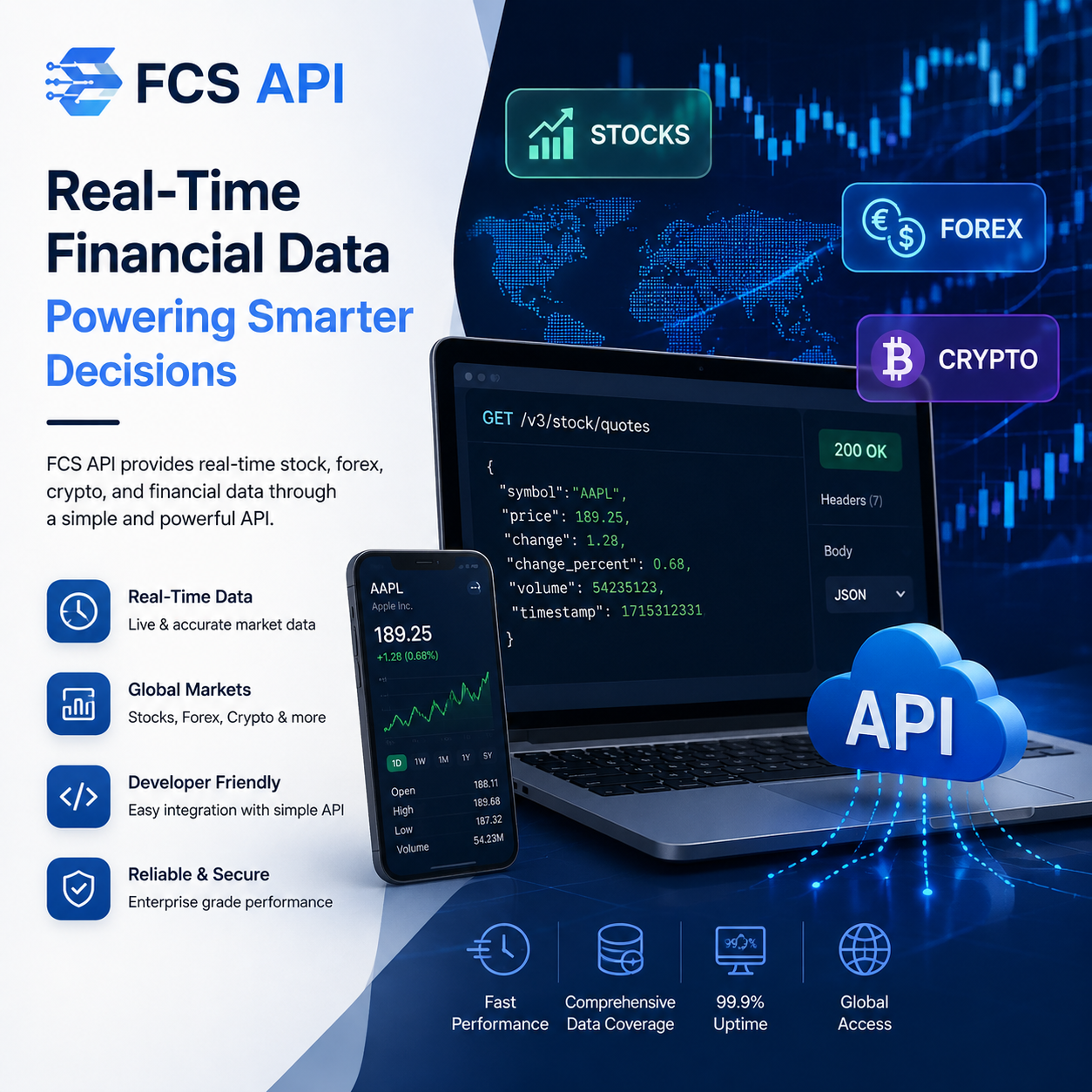
FCS API, for example, covers stocks, cryptocurrencies, forex, commodities, ETFs, and indices, allowing users to explore multiple financial markets through one platform.
Evaluate Data Quality
Having a large amount of data is not enough. The information should also be reliable and suitable for your application.
Understand the Data Source
Before integrating an API into an important financial product, learn where its market information comes from.
Understanding the provider’s data sources can help you evaluate whether the information is suitable for your intended use.
Check Accuracy and Consistency
Financial applications depend on consistent information. Incorrect or inconsistent data can create problems for dashboards, charts, research tools, and other features.
Developers should test API responses and compare available information with reliable market sources when evaluating a provider.
Review API Documentation
Good documentation can make a major difference during development.
Look for Clear Instructions
API documentation should explain how developers can connect to the service and request data.
It should provide information about endpoints, parameters, authentication, response formats, and available features.
Clear instructions can reduce the time needed to understand the API.
Check for Examples
Examples can be particularly helpful for developers who are new to financial APIs.
Sample requests and responses allow developers to understand how the API works and how the returned information should be handled inside an application.
Consider API Request Limits
Free services commonly have usage restrictions. These restrictions can affect how many requests your application can make within a particular period.
Understand Daily or Monthly Limits
Before choosing a free stock data api, check how many requests are available.
A small personal project may require only a limited number of requests. However, a financial platform with many users could quickly reach a free usage limit.
Understanding these restrictions helps prevent unexpected interruptions.
Think About Future Growth
Your project may start small but grow over time.
If the application becomes popular, the number of API requests could increase significantly. Check whether the provider offers higher limits or paid options if you eventually need additional capacity.
This can make it easier to scale without completely rebuilding your application.
Check Ease of Integration
A good API should not unnecessarily complicate the development process.
Look at Supported Technologies
Developers may use different programming languages and frameworks. Check whether the API can be easily integrated with the technology your application uses.
Common API formats and clear documentation can make integration easier.
Test the API Before Building
If possible, test the API before committing your entire project to it.
Try a few requests and examine the responses. Check how quickly information is returned and whether the data is structured in a way that works for your application.
Testing early can help identify problems before significant development time is invested.
Look at Historical Data Availability
Historical market data is important for many financial applications.
Why Historical Data Matters
Historical prices allow users to study how stocks have performed over different periods.
A financial platform can use historical information to create charts, comparisons, and research tools. Developers can also use it to build educational features that show how market prices have changed.
Check the Available Time Period
Not every API provides the same amount of historical information.
Some may offer a limited period, while others may provide longer historical records. Check whether the available history matches your project’s requirements.
Consider Charts and Visualization Features
Market data is easier to understand when it is presented visually.
Turning Numbers Into Charts
Raw market data can contain many numbers that are difficult for users to interpret. Charts can make price movements easier to understand.
A platform can use API data to create line charts, historical price charts, and other visual features.
Building Better User Experiences
Good visualization can make a financial application more useful. Users can quickly identify price changes and compare different periods without reading long lists of numbers.
If charts are an important part of your project, make sure the API provides data in a format that can easily support your visualization system.
Check Security and Authentication
Security should always be considered when integrating an API into an application.
Protect API Credentials
Many APIs require an API key or another form of authentication.
Developers should avoid exposing private credentials directly in public-facing code. Proper security practices can help prevent unauthorized use of API access.
Understand Authentication Methods
Read the provider’s documentation to understand how authentication works.
A clear and secure authentication system can make integration easier while helping developers protect their applications.
Consider Reliability and Support
An API can become an important part of a financial platform, so reliability matters.
Look for Stable Service
Frequent outages can affect applications that depend on market data.
Developers should consider the provider’s reliability and whether it communicates service issues or maintenance clearly.
Check Available Support
Documentation is useful, but developers may sometimes need additional assistance.
Check whether the provider offers support resources, technical documentation, FAQs, or other ways to resolve integration problems.
How FCS API Can Be a Useful Option
FCS API is a financial information platform that provides financial API market data, news, and analysis for global financial markets.
Multiple Financial Markets
FCS API covers stocks, cryptocurrencies, forex, commodities, ETFs, and indices. This broad coverage can be useful for users who want to build or explore applications involving different asset classes.
Having access to multiple markets can also provide room for future development if a project expands beyond stocks.
Market Data and Additional Resources
The platform also offers charts, economic updates, financial news, and educational content.
These resources can complement market data and help users understand price movements and broader financial trends.
For developers building financial tools, combining market information with charts and educational resources can create a more complete experience.
Compare Free and Paid API Features
The word “free” should not be the only factor in your decision.
Understand What Is Included
Check exactly what the free version provides. Some free plans may include limited requests, selected data, or specific endpoints.
Understanding these restrictions helps you determine whether the service can actually support your project.
Consider the Long-Term Cost
If your application grows, you may eventually need more requests or additional features.
Look at the provider’s available upgrade options and pricing structure before starting development. This can help you estimate potential future costs.






Post Comment