How Memoir Writing Keeps Family History Alive
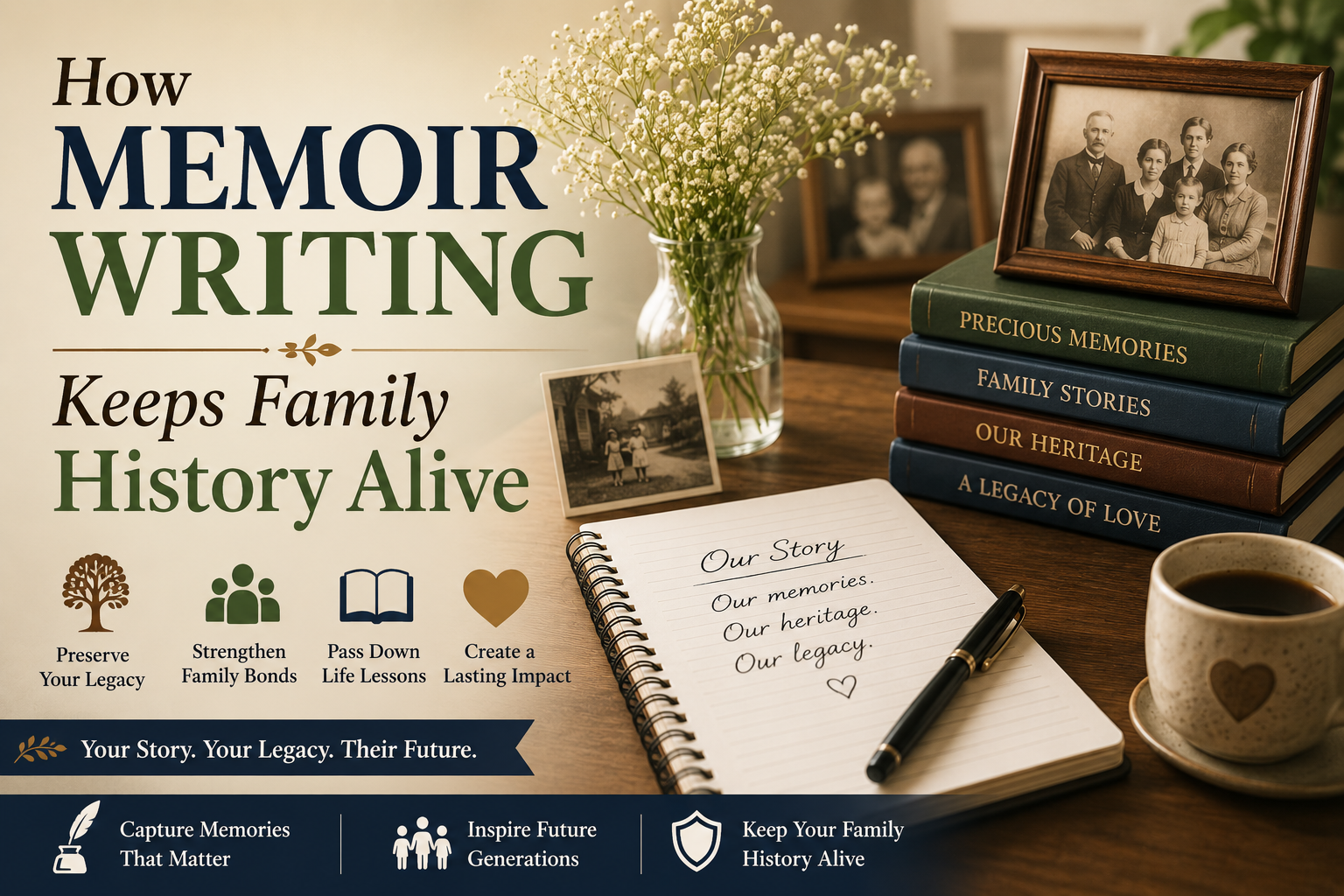
There are stories sitting in your family right now tucked inside an aging parent’s memory, folded into the pause before your grandmother answers a question, living in the silence between what was experienced and what was ever written down. Most of those stories will disappear. Not because no one cared, but because no one made the time. Memoir writing services exist precisely to close that gap before it becomes permanent.
Why Family Stories Are Lost And What It Costs Us
Every family has a version of the same story: a relative who lived through something extraordinary a migration across continents, a childhood during wartime, a life built from nothing in a country that didn’t speak their language and whose account of it existed only in conversation. At family dinners. In bedtime stories. In the way they described their hands when they talked about work. And then, one day, that person was gone. And the story went with them.
This is not a rare tragedy. It is the default outcome for most family histories.
Oral traditions are fragile. Memory fades, details blur, and the people who carry the most history are often the least likely to believe their story is worth preserving. They lived it, so it feels ordinary to them. What feels ordinary to one generation becomes irreplaceable to the next.
The loss runs deeper than sentiment. When family stories go undocumented, what disappears with them is a family’s sense of identity the thread connecting who you are today to the people and places that shaped you. Children and grandchildren grow up without context for their own names, their traditions, their values. The ancestral stories that could have given them roots instead become rumors, and eventually silence.
The good news is that this is entirely preventable. And it does not require anyone to become a writer.
What Is Memoir Writing And How Is It Different From an Autobiography?
Before exploring how memoir writing preserves family history, it helps to understand what a memoir actually is because the term is often used interchangeably with autobiography and biography, and the differences matter when choosing how to tell a story.
A memoir is a focused, first-person narrative drawn from personal experience. Unlike an autobiography, which covers the arc of an entire life from birth to the present, a memoir tends to zoom in on a particular decade, a defining relationship, an immigration journey, a career, or a period of survival and transformation. It is not a complete record; it is a curated, emotionally honest account of what mattered most.
An autobiography tells the whole life story, chronologically and comprehensively. It suits someone whose full life arc carries significance a community elder, a long-serving professional, a family patriarch or matriarch whose entire journey deserves documentation.
A biography, by contrast, is written about someone by another person often a professional writer, a family member, or a hired biographer who researches and constructs the narrative from interviews, documents, and records.
Professional memoir writing services work across all three formats, and the best ones help clients decide which approach fits their story before a single word is written. Some families want a slim, deeply personal memoir of one grandparent’s immigration experience. Others want a sweeping family history book spanning four generations. Others simply want an oral history a transcribed, lightly edited record of recorded conversations. All of these are valid. All of them constitute legacy writing, and all of them are forms of preservation.
How Memoir Writing Keeps Family History Alive for Future Generations
The most fundamental thing a memoir does is make a story permanent.
A memory exists only as long as the person holding it. A written memoir or a recorded and transcribed oral history exists independently of the person who lived it. It can be read by a great-grandchild who was born decades after the storyteller’s death. It can be shared at a family reunion, donated to a local historical archive, or simply kept on a shelf where it waits to be discovered by someone who needed exactly that story at exactly the right time.
This is what makes memoir writing one of the most meaningful acts of intergenerational storytelling a family can undertake. It transforms lived experience into a family archive a permanent, accessible record that captures not just events, but the voice, values, humor, and humanity of the people who shaped the family.
It creates identity
For children and grandchildren, reading a grandparent’s memoir is often the first time they understand where their own personality traits, resilience, or worldview came from. Heritage documentation of this kind gives descendants a sense of roots a feeling of being part of something larger than their own immediate experience.
It preserves what photographs cannot
Photos show faces and places. A memoir explains what it felt like to live in them. The context behind the image the fear, the joy, the sacrifice, the humor lives in the written word, not the frame.
It becomes a family heirloom
A professionally produced memoir or family history book occupies the same emotional category as a grandmother’s ring or a great-grandfather’s watch. It is a physical object that carries meaning across generations. Families report that printed memoir books become among their most treasured possessions passed from sibling to sibling, read at milestone events, gifted to newborns as an introduction to who came before them.
It heals
The act of writing or being interviewed and having one’s story written is consistently described by participants as clarifying and cathartic. Storytellers find language for experiences they had only half-processed. Families discover shared history they never knew they had. The process of preserving memories for future generations often strengthens the bonds of the present.
What to Expect From Professional Memoir Writing Services
Many people assume that using a memoir writing service means handing over a folder of notes and receiving a book in the mail. The reality is far more collaborative, and far more personal.
Here is what the process typically looks like with a full-service provider:
Discovery and interviews
The process begins with a series of recorded conversations between the subject and a professional writer or personal historian. These sessions conducted in person, by phone, or via video are designed to draw out the full depth of a person’s story. A skilled interviewer knows how to ask the questions that unlock the memories a person didn’t know were still there. Sessions typically range from three to ten interviews, depending on the scope of the project.
Research and historical context
Quality memoir writing services go beyond personal recollection. They cross-reference dates, locations, and events against historical records, genealogical databases, and family documents. This gives the final narrative accuracy and texture the story of a person’s life set against the backdrop of the world they lived in.
Drafting in the subject’s voice
This is where the ghost-writing craft comes in. The professional writer’s job is to disappear into the subject’s voice to produce a manuscript that reads as if the storyteller wrote it themselves. A good memoir ghostwriter is not imposing style; they are channeling it. The result should feel unmistakably like the person whose story it tells.
Revision and approval
Memoir writing is iterative. Clients review drafts, offer corrections, and shape the narrative until it feels right. Reputable services build multiple revision rounds into their packages the subject’s satisfaction is the only standard that matters.
Final production
Depending on the service, the deliverable may be a polished manuscript, a professionally designed and printed hardcover book, a digital file, an audio recording, or all of the above. Some services include family photo integration, custom design, and limited print runs for family distribution.
Who Benefits Most From Memoir Writing Services?
Memoir writing services are not just for the famous or the elderly. They serve a wide range of families, at different stages, for different reasons.
Adult children of aging parents represent the largest and most urgent audience. The window for capturing a parent’s or grandparent’s story is real and finite. Many adult children describe hiring a memoir writing service as one of the most meaningful gifts they have ever given both to their parent, who gets to experience the dignity of having their story honored, and to the family, who receives something they will treasure long after the storyteller is gone.
Seniors who want to tell their own story often have rich, remarkable lives and no idea how to put them on paper. Many find writing intimidating, or simply don’t know where to start. Professional memoir writing services remove that barrier entirely no writing required from the subject, only a willingness to talk.
Families with immigrant or multicultural heritage have a particularly urgent relationship with memoir writing. When families cross cultural and linguistic borders, stories are among the first things at risk of being lost. Multilingual family history writing services exist specifically to serve these families, preserving heritage in the language and context it belongs to.
Families navigating a significant life milestone a 90th birthday, a death in the family, a generational gathering often find that these moments crystallize the desire to document what has been lived. A memoir commission makes a profound gift at any of these occasions.
How to Choose the Right Memoir Writing Service for Your Family
Not all memoir writing services are built the same way, and choosing the right one depends on your family’s needs, budget, and goals. Here are the questions worth asking before committing:
Do they write in the subject’s voice?
This is the most important criterion. A ghostwriter who imposes their own style produces a book that sounds like a ghostwriter. Ask for sample work and verify that past clients feel the final product sounds like them.
How many interview sessions are included?
A single interview session cannot capture a full life. Look for services that include a minimum of three to five recorded sessions, with the option to expand.
Is genealogical research part of the package?
The most comprehensive memoir writing services integrate genealogical research into the narrative verifying facts, locating historical records, and providing the context that turns a personal story into a documented history.
What is the final deliverable?
Clarify whether you want a manuscript, a printed book, a digital archive, or a combination. Understand printing costs for additional copies upfront.
Are DIY hybrid options available?
For families on a tighter budget, guided platforms like StoryWorth or Remento offer a middle path structured prompts, recorded responses, and lightly edited books produced over months. These are not the same as full ghostwriting services, but they serve families who want a meaningful record without the investment of a full professional engagement.
What do past clients say?
Testimonials from families who have completed the process are the most reliable indicator of quality. Look for specificity not just “it was wonderful,” but evidence that the service captured voice, handled sensitive material with care, and delivered on its promises.
Frequently Asked Questions About Memoir Writing Services
How much do memoir writing services cost?
The range is wide. Guided DIY platforms typically cost between $99 and $200 per year. Full-service memoir ghostwriting which includes interviews, research, drafting, editing, and production generally ranges from $5,000 to $30,000 or more, depending on the length, complexity, and experience level of the writer. Some families commission a modest project; others invest in a multi-generational family history book spanning hundreds of pages.
How long does it take to complete a memoir?
DIY platforms typically take six to twelve months, working at the storyteller’s own pace. Professional ghostwriting services generally deliver a completed manuscript in three to nine months, with printed production adding additional time depending on the publisher.
What if the person whose story we want to capture has difficulty writing or typing?
This is not an obstacle. Nearly all professional memoir writing services are built around recorded interviews the subject speaks, and the professional writer does the rest. No writing ability is required. Some services now offer AI-assisted phone call interviews that call the subject weekly, making participation as simple as having a conversation.
Can memoir writing services handle stories in languages other than English?
Yes. As families with diverse linguistic backgrounds increasingly seek to preserve their heritage, multilingual family history writing services have become more widely available. When choosing a service for a non-English story, confirm that the writer has genuine fluency in the relevant language and cultural context not just translation capability.
Is the memoir kept private, or can it be published?
Both paths are available. The majority of families who commission memoir writing services opt for private publication a limited print run distributed to family members, produced to heirloom quality. Others pursue commercial publication, particularly if the story has historical significance or broad appeal. Your service provider should be able to advise on both options.
Start Preserving Your Family’s Story Today
Every family contains a library of stories. Most of those libraries have never been written down. And every year that passes without documentation is a year in which the stories grow a little more distant from the people who lived them.
Memoir writing services exist to make preservation accessible not just for families with famous histories, but for any family that understands the quiet, irreplaceable value of knowing where they came from. The story of a grandmother who raised six children through hardship. A grandfather’s immigration journey told in his own words. A parent’s account of the decade that made them who they are.
These are not small stories. They are the foundation of family identity the living link between the past and every generation still to come.
The right time to begin is always now, while the voices are still here to speak.


Post Comment