Arc Welding Process: How It Works, Common Methods, and Practical Applications
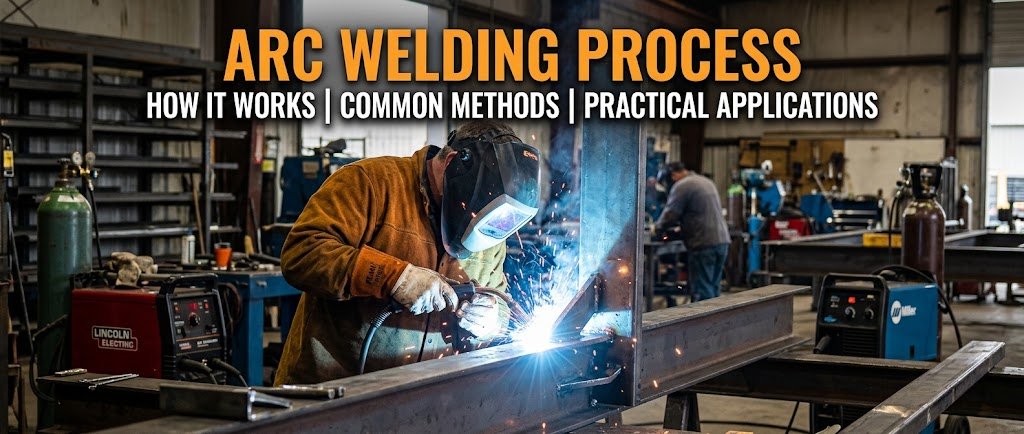
The arc welding process uses an electric arc to generate enough heat to melt and join metal surfaces. An electrical current passes between an electrode and the workpiece, creating an intense arc that melts the base metal and, depending on the method, a filler metal. As the molten material cools, it forms a strong permanent joint. This basic principle supports several widely used welding methods across manufacturing, construction, automotive repair, fabrication, and maintenance in the United States.
Understanding how arc welding works is useful for anyone involved in metal fabrication or industrial work because the quality of a welded joint depends on more than simply producing heat. Electrode selection, current settings, shielding, joint preparation, travel speed, and the type of metal all influence the finished weld.
What Is the Arc Welding Process?
At its simplest, arc welding creates a controlled electrical arc between an electrode and a metal workpiece. The arc produces concentrated heat that can reach temperatures high enough to melt steel and other metals.
There are two general electrode arrangements. In some welding methods, the electrode is consumed during welding and becomes part of the joint as filler metal. In others, the electrode remains intact while a separate filler material may be introduced.
The welding power source supplies either alternating current (AC), direct current electrode positive (DCEP), or direct current electrode negative (DCEN), depending on the particular welding method and application. Choosing the appropriate electrical setup affects penetration, arc characteristics, heat distribution, and electrode performance.
Shielding is another important consideration. Molten metal can react with oxygen, nitrogen, and other elements in the surrounding atmosphere. Welding processes therefore use shielding gas, flux, or a combination of both to protect the weld area from atmospheric contamination.
For example, a fabrication shop welding structural steel may select a process that provides consistent penetration and productivity, while a maintenance technician repairing equipment in an outdoor environment may prioritize portability and resistance to changing conditions.
Common Types of Arc Welding
Arc welding is not a single technique. It describes a group of welding processes that use an electric arc as the primary heat source.
Shielded Metal Arc Welding (SMAW) is commonly known as stick welding. It uses a flux-coated consumable electrode. When the electrode melts, the flux produces shielding gases and a layer of slag that helps protect the weld as it solidifies. SMAW equipment is relatively portable, making it useful for construction, field repairs, maintenance, and work in locations where shielding gas may be difficult to manage.
Gas Metal Arc Welding (GMAW), often called MIG welding, feeds a continuous consumable wire electrode through a welding gun. Shielding gas protects the molten weld pool. MIG welding is widely used in fabrication because it can provide relatively high deposition rates and is suitable for many production environments.
Gas Tungsten Arc Welding (GTAW), commonly called TIG welding, uses a non-consumable tungsten electrode. The process offers precise control of the arc and weld pool. TIG is frequently selected where appearance, control, and weld quality are particularly important, including work involving stainless steel, aluminum, and thinner materials.
Flux-Cored Arc Welding (FCAW) uses a tubular wire containing flux. Depending on the specific process, additional shielding gas may or may not be required. FCAW can provide high productivity and good penetration, making it useful for heavy fabrication, structural applications, and certain outdoor welding operations.
Each method has advantages and limitations. There is no universal welding process that is best for every material, thickness, position, environment, and production requirement.
Key Factors That Affect Weld Quality
A technically sound welding procedure starts with selecting settings appropriate for the material and joint.
Current and voltage are fundamental variables. Too little current can result in inadequate fusion or penetration, while excessive current can produce excessive heat, distortion, or burn-through on thinner materials.
Travel speed also matters. Moving the electrode too quickly can produce a narrow weld with insufficient fusion. Moving too slowly can increase heat input and create an unnecessarily large weld bead.
Electrode selection should match the material and welding requirements. Different electrodes and filler metals have different mechanical and chemical characteristics. In professional fabrication, the filler metal is selected based on the base material, joint requirements, applicable specifications, and service conditions.
Joint preparation can be equally important. Contaminants such as oil, paint, rust, moisture, or scale can interfere with welding and contribute to defects. Proper cleaning and preparation help create more consistent results.
Welding position is another practical consideration. Flat, horizontal, vertical, and overhead welding can require different techniques and settings. Gravity affects the molten weld pool, so a welder must control arc length, travel speed, and electrode angle accordingly.
Organizations such as American Welding may discuss these fundamentals as part of broader welding education, but actual welding procedures should always follow the applicable specifications, equipment instructions, and qualified procedures for the job.
Where Arc Welding Is Used in the United States
Arc welding supports a wide range of American industries. Structural steel fabrication is one familiar example, where welded connections are used in buildings, bridges, industrial structures, and other infrastructure.
Manufacturing facilities also rely on welding to assemble machinery, frames, components, tanks, and fabricated assemblies. Automotive and transportation applications can involve welding of steel, aluminum, and other alloys, with the specific process selected according to production requirements.
In agricultural and heavy equipment maintenance, welding may be used to repair worn components, reinforce structures, or restore damaged machinery. Field welding presents additional challenges because wind, weather, accessibility, and power availability can affect the work.
Consider a repair performed at a construction site. A portable stick welding machine may be more practical than a gas-shielded process because transporting and maintaining shielding gas can be inconvenient. By contrast, a controlled manufacturing line may favor MIG or another continuous-wire process because automation and repeatability are important.
These examples illustrate why process selection should be based on the actual working conditions rather than simply choosing the most familiar welding method.
Safety and Quality Considerations
Arc welding involves intense heat, ultraviolet radiation, molten metal, electrical energy, fumes, and potentially hazardous gases. Appropriate personal protective equipment is therefore essential. A welding helmet with the correct lens shade, flame-resistant clothing, welding gloves, suitable footwear, and appropriate eye and face protection are basic considerations.
Ventilation and fume control are also important, particularly when welding coated, painted, stainless, or otherwise treated materials. The work area should be evaluated for combustible materials, electrical hazards, confined-space concerns, and other site-specific risks.
Quality control extends beyond visual appearance. A weld can look acceptable while containing problems such as lack of fusion, porosity, cracking, undercut, or insufficient penetration. Depending on the application, inspection may involve visual examination, dimensional checks, or nondestructive testing methods.
Professional welding operations may work from welding procedure specifications (WPS), qualified welders, inspection requirements, and applicable industry codes. These controls help ensure that welded joints meet the mechanical and service requirements expected of the finished structure or component.
Conclusion
The arc welding process is based on a straightforward principle: an electrical arc generates concentrated heat that melts metal and allows a permanent joint to form. In practice, successful welding requires careful control of current, voltage, electrode or wire selection, shielding, travel speed, joint preparation, and welding position.
SMAW, GMAW, GTAW, and FCAW each provide different capabilities, making arc welding adaptable to everything from field repairs to highly controlled manufacturing. Understanding those differences helps welders, fabricators, engineers, and maintenance professionals choose a suitable method for a particular job.
Ultimately, reliable welding comes from combining the right process with proper preparation, qualified procedures, safe working practices, and appropriate inspection. That combination is what turns the basic heat of an electrical arc into a durable and dependable metal joint.






Post Comment