Press Release Distribution vs Digital Marketing: What’s the Difference?
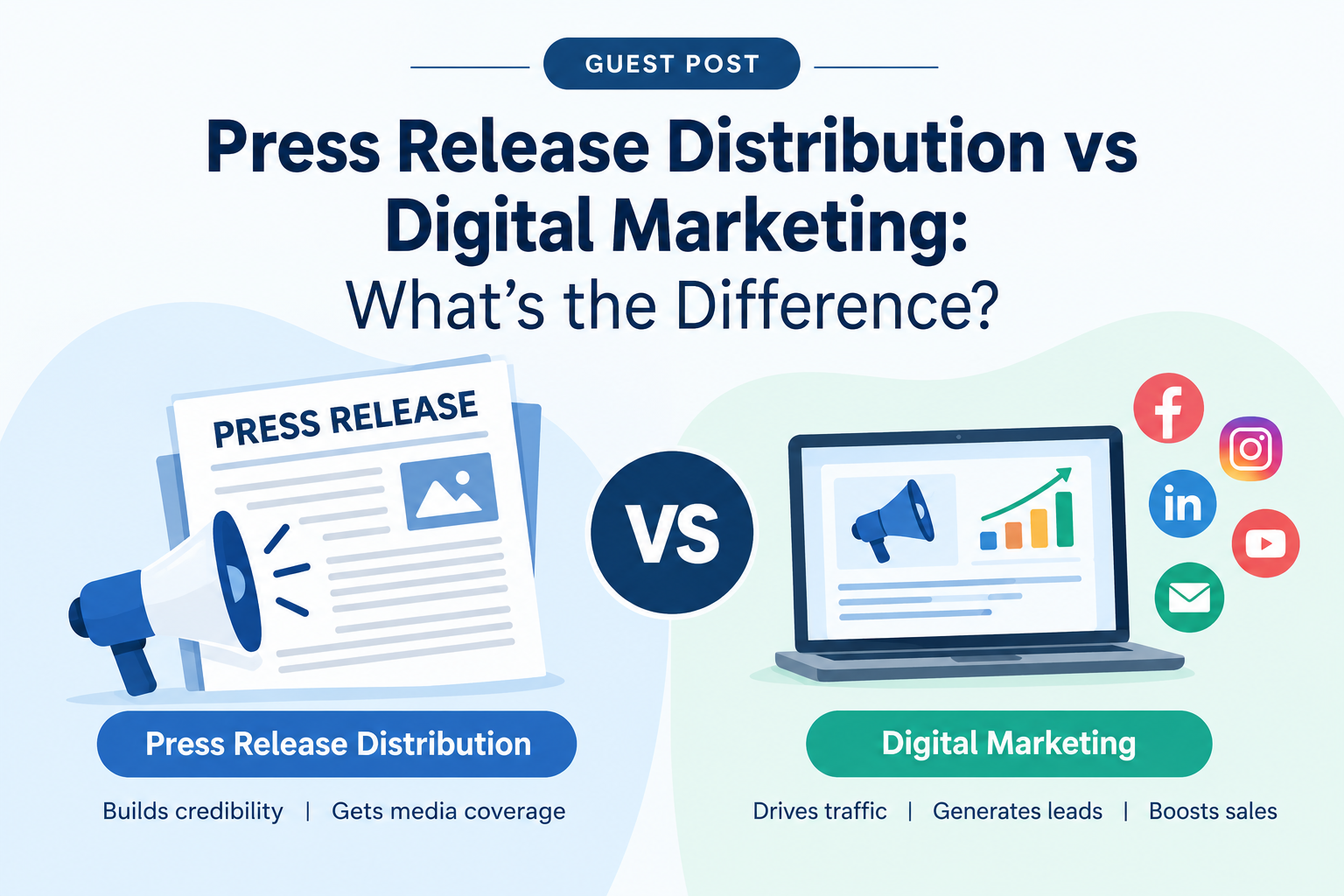
Businesses in the United States have more ways than ever to communicate with customers, journalists, investors, and industry audiences. Two commonly discussed approaches are press release distribution and digital marketing. Although they can support similar goals, they serve different purposes and operate through different channels.
Understanding the difference between these approaches can help organizations decide how to communicate company news, build awareness, and maintain a consistent online presence.
Press releases are traditionally associated with newsworthy announcements, while digital marketing covers a much broader range of online promotional and communication activities. Neither approach is automatically better than the other. Their effectiveness depends on the organization’s goals, audience, message, timing, and overall communications strategy.
What Is Press Release Distribution?
Press release distribution is the process of making a company’s official news announcement available to journalists, media organizations, publications, industry professionals, and online audiences through distribution networks.
A press release typically communicates a specific piece of news. Examples may include:
- A new product or service launch
- A corporate partnership
- An executive appointment
- A business expansion
- A merger or acquisition
- An event announcement
- New research or survey findings
- An award or significant company achievement
- A funding announcement
- A major organizational development
The purpose is primarily to communicate information rather than create a conventional advertising message.
A properly prepared release generally answers fundamental questions such as who, what, when, where, why, and how. It may also include quotes from company representatives, supporting facts, background information, and contact details.
What Is Digital Marketing?
Digital marketing is a much broader discipline. It involves using internet-based channels to communicate with audiences, build awareness, generate traffic, nurture relationships, and support business objectives.
Common digital marketing activities include:
- Search engine optimization (SEO)
- Pay-per-click advertising
- Social media marketing
- Content marketing
- Email marketing
- Display advertising
- Video marketing
- Influencer marketing
- Conversion optimization
- Online reputation management
Unlike a press release, digital marketing is not limited to newsworthy events. It can operate continuously and cover different stages of the customer journey.
For example, an American e-commerce company might use SEO to attract people searching for its products, social media to engage existing followers, email campaigns to communicate with subscribers, and paid advertising to reach potential customers.
The Main Difference Between Press Releases and Digital Marketing
The simplest distinction is news communication versus ongoing audience marketing.
A press release usually exists because something noteworthy has happened. Digital marketing can continue regardless of whether the company has a new announcement.
Consider a technology startup preparing to launch a new software platform.
The company could issue a press release announcing the launch. The release provides factual information about the product and the company’s announcement.
At the same time, the marketing team might create blog articles, social media posts, search campaigns, email sequences, videos, and landing pages to educate potential customers and encourage engagement.
In this example, the press release communicates the news, while digital marketing supports the broader marketing strategy around that news.
Purpose and Intent
The intent behind a press release is generally informational.
A press release should provide journalists and readers with useful, factual information about an event or development. Excessive promotional language can reduce its credibility and make it less suitable for editorial consideration.
Digital marketing, on the other hand, can have many objectives. Depending on the campaign, it may aim to:
- Generate leads
- Increase website traffic
- Drive sales
- Build brand awareness
- Improve customer retention
- Increase engagement
- Educate an audience
- Encourage downloads or registrations
This difference in intent is important when deciding which communication method to use.
Audience Differences
Another significant difference involves the intended audience.
Press releases are often written with both media professionals and the general public in mind. Journalists may use announcements as a starting point for research or potential news coverage.
Digital marketing tends to use more specific audience segmentation. A company can create different campaigns for different demographics, interests, locations, behaviors, or stages of the purchasing journey.
For example, a U.S.-based financial technology company might issue one press release about a strategic partnership. Its digital marketing strategy could then target small-business owners, financial professionals, existing customers, and prospective users with different content.
Distribution Channels
Press releases are distributed through newswires, media distribution networks, company newsrooms, and other appropriate channels.
Professional Newswire Services can provide infrastructure for distributing announcements to multiple media and online destinations. Distribution networks vary in their geographic reach, audience categories, editorial processes, and available reporting.
Organizations should evaluate a distribution service based on factors such as:
- Geographic coverage
- Industry relevance
- Distribution network
- Editorial standards
- Reporting capabilities
- Archive availability
- Formatting requirements
- Transparency about distribution
For businesses targeting the United States, geographic relevance is particularly important. A national announcement may require broader distribution than a release concerning a local business development.
Digital marketing uses a wider collection of platforms. These may include Google and other search engines, social networks, websites, newsletters, advertising platforms, podcasts, video platforms, and third-party publications.
Timing and Frequency
Press releases are usually event-driven.
A company may issue a release when it has meaningful news to communicate. Publishing frequent announcements without genuinely newsworthy developments can make communications less useful to journalists and audiences.
Digital marketing is generally more continuous.
An organization may publish SEO content every week, maintain social media activity, run paid campaigns throughout the year, and send email newsletters on a regular schedule.
This creates a fundamental difference:
Press releases are typically announcement-based, while digital marketing is generally campaign- and relationship-based.
SEO and Search Visibility
SEO is another area where the two strategies can overlap.
A distributed press release may appear on news and business websites and can help make an organization’s announcement easier to discover online. However, companies should not assume that every press release will directly improve search rankings.
Search engines evaluate many factors when determining rankings, including relevance, content quality, authority, user experience, and technical signals.
Press releases should therefore be treated primarily as communications assets rather than shortcuts to higher rankings.
Digital marketing has a more direct relationship with SEO because SEO itself is a major digital marketing discipline. Businesses can optimize their websites, create useful content, improve technical performance, build authoritative references, and target relevant search queries.
A sustainable SEO strategy typically requires ongoing effort rather than relying on individual announcements.
Credibility and Third-Party Attention
One potential benefit of a well-prepared press release is that it can place an organization’s announcement into a format that is familiar to media professionals.
However, distribution does not guarantee independent editorial coverage.
This distinction is essential.
Having a press release distributed is not the same as having a journalist independently write a story about the company. Earned media coverage requires editorial interest and may involve additional research, interviews, or verification.
Organizations should also distinguish between paid distribution, owned media, earned media, and advertising when evaluating communication results.
For example, Vertex Newswire may be used as part of a company’s broader news distribution approach, but the resulting visibility should still be evaluated according to the actual distribution and coverage achieved rather than assuming that publication automatically represents independent media endorsement.
Measuring Results
The measurement methods for these two approaches can also differ.
Press release distribution may be evaluated using metrics such as:
- Distribution reach
- Potential audience
- Pickup or publication counts
- Referral traffic
- Engagement with the announcement
- Media inquiries
- Resulting editorial coverage
- Brand mentions
Digital marketing provides a much wider range of measurable performance indicators.
Depending on the channel, marketers may monitor:
- Website sessions
- Click-through rates
- Conversion rates
- Cost per acquisition
- Leads
- Sales
- Search visibility
- Email open and click rates
- Social engagement
- Return on advertising spend
The most useful measurement depends on the original objective.
A press release intended to communicate an acquisition announcement should not necessarily be judged by the same metrics as a paid advertising campaign designed to generate online purchases.
When Should a Business Use a Press Release?
A press release can be appropriate when an organization has information that has legitimate news value.
For example, a company might consider a release for:
Product Launches
A genuinely significant product introduction can provide a clear reason for an announcement.
Partnerships
A strategic partnership may be newsworthy when it has meaningful implications for customers, markets, or the organizations involved.
Expansion
Opening a new facility, entering a new market, or expanding operations can provide a clear news angle.
Leadership Changes
Important executive appointments or organizational changes may warrant formal communication.
Research and Data
Original research, surveys, or significant findings can be particularly useful when supported by credible methodology and relevant data.
The key principle is simple: the announcement should contain actual news rather than simply functioning as an advertisement.
When Is Digital Marketing More Appropriate?
Digital marketing is generally more appropriate when the objective involves ongoing audience development or measurable marketing activity.
For example, a business may use digital marketing to:
- Improve organic search visibility
- Build an email subscriber base
- Educate potential customers
- Promote products
- Generate leads
- Retarget website visitors
- Develop social communities
- Improve customer retention
Digital marketing is particularly useful when organizations need continuous communication rather than a single announcement.
Can Press Releases and Digital Marketing Work Together?
Yes. In many cases, the strongest communication strategy combines both.
Imagine a U.S. company launching an innovative consumer product.
The organization could first prepare a factual press release announcing the launch. The announcement could communicate the key details and provide journalists with relevant background information.
The digital marketing team could then support the broader launch with:
- Search-optimized website content
- Educational blog articles
- Social media content
- Email communication
- Video demonstrations
- Paid advertising
- Landing-page optimization
- Audience retargeting
The press release becomes one component of the communication strategy rather than the entire strategy.
This approach also helps separate responsibilities. Public relations can focus on news and media relationships, while marketing focuses on audience acquisition, engagement, and conversion.
How to Choose the Right Approach
The decision should begin with the objective.
Ask these questions:
Is there genuine news?
If yes, a press release may be appropriate.
Is the goal continuous customer acquisition or engagement?
Digital marketing may be more suitable.
Is the organization trying to communicate a major corporate development?
A press release can provide an official announcement format.
Does the company need measurable conversions?
Digital marketing channels generally provide more direct conversion tracking.
Can both objectives apply?
Using a press release alongside digital marketing may provide a more comprehensive communications strategy.
Best Practices for U.S. Organizations
U.S. businesses should focus on accuracy, transparency, relevance, and clear sourcing.
A credible press release should identify the organization responsible for the announcement, provide accurate claims, use attributable quotations, and avoid unsupported statements.
Marketing content should follow applicable advertising and consumer-protection requirements as well. Organizations should be careful with claims involving health, financial outcomes, product performance, environmental benefits, or other areas where unsupported claims could mislead consumers.
It is also important to keep records of factual sources and approvals, especially for announcements involving financial information, partnerships, research findings, or regulated industries.
Final Thoughts
Press release distribution and digital marketing are complementary rather than competing strategies.
Press release distribution is primarily designed to communicate news and organizational developments. Digital marketing is a broader discipline focused on reaching, engaging, and converting online audiences over time.
A press release can help an organization formally announce an important development, while digital marketing can provide the ongoing content, search visibility, advertising, and audience engagement needed to support broader business objectives.
For U.S. organizations, the most effective approach is usually determined by the nature of the message and the desired outcome. When there is genuine news, a well-written press release can provide a structured way to communicate it. When the goal is sustained audience growth or customer engagement, digital marketing offers a wider range of tools.
Understanding the role of each approach allows businesses to use them strategically, measure their results realistically, and avoid treating press releases or digital marketing as one-size-fits-all solutions.



Post Comment