Best Fabrics for Branded Workwear in Dubai’s Climate
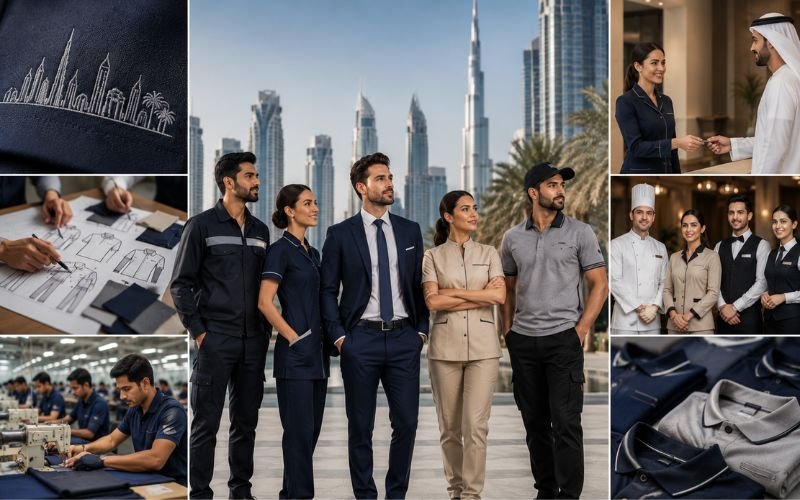
Dubai’s heat doesn’t forgive bad fabric choices. I’ve seen companies spend tens of thousands of dirhams on corporate uniforms — sharp embroidery, sleek cuts, beautiful branding — only to have staff sweating through them by 9 AM. The workwear looked great in the showroom and fell apart in real life.
After years of working with businesses across hospitality, construction, retail, and facilities management in the UAE, here’s what I’ve learned about fabric selection that no product catalogue will tell you.
Why Dubai’s Climate Demands a Different Approach
Most workwear fabric guides are written for European or North American climates. Useful baseline information, but not the full story here.
Dubai sits between 38°C and 48°C for roughly six months of the year. Humidity in coastal areas — Deira, JBR, the Marina — regularly hits 80–90% during summer mornings. Then you have indoor environments: malls and offices blasting AC at 20°C, which staff move in and out of constantly. A fabric that handles outdoor heat might leave someone shivering inside. That temperature swing is genuinely difficult to dress for.
Outdoor workers — security staff, delivery teams, construction crews, outdoor F&B — deal with direct sun exposure for hours. Indoor staff in hotels and retail face a different problem: high activity in air-conditioned spaces where breathability still matters but thermal comfort shifts.
The fabric choice isn’t one-size-fits-all. It never should be.
The Best Fabrics for Branded Workwear in Dubai
Cotton: Still the Default, But with Caveats
Pure cotton remains the most popular choice among businesses ordering uniforms for the first time. And honestly, for indoor environments with moderate activity, 100% cotton — particularly combed cotton in the 160–180 GSM range — does the job well. It’s breathable, it takes printed and embroidered branding cleanly, and staff generally find it comfortable.
The problem is durability under repeated industrial washing. Hospitality businesses in particular wash uniforms daily at high temperatures. Pure cotton loses shape, fades, and pills faster than most operators expect. After 30–40 washes, a ` cotton polo that looked polished on day one starts looking tired.
My honest opinion: pure cotton is the right call only if you’re replacing uniforms every 6–8 months anyway, or if your staff are primarily in cooler indoor settings.
Cotton-Polyester Blends: The Practical Workhorse
A 65% polyester / 35% cotton blend is what most experienced business uniform providers in the UAE recommend for general staff uniforms — and for good reason. The polyester adds dimensional stability (the shirt keeps its shape), improves colour retention, and significantly extends garment life.
The trade-off is breathability. Polyester doesn’t wick moisture the same way natural fibres do. For outdoor or high-activity roles, a straight poly-cotton blend gets uncomfortable fast.
The sweet spot I’ve seen work well in practice: 50/50 blends for roles with mixed indoor/outdoor exposure, like retail staff in open-concept stores or hotel bell teams. Better breathability than 65/35 without sacrificing too much durability.
Performance Polyester and Moisture-Wicking Fabrics
For outdoor roles — security guards, valet staff, outdoor event crew, construction site supervisors — performance polyester is genuinely the best fabrics for branded workwear in Dubai conditions. These are the fabrics built for athletic wear, repurposed for workwear, and they outperform everything else when the sun is directly overhead.
Look specifically for fabrics with:
- Moisture-wicking technology (draws sweat away from skin)
- UPF 30+ or 50+ ratings (important for anyone outdoors more than 3–4 hours)
- Mechanical stretch (4-way stretch fabrics reduce fatigue over long shifts)
The branding challenge with performance polyester is real. Embroidery works fine. Screen printing and heat transfer sometimes peel or crack faster on high-stretch fabrics. A good business uniform provider UAE will run a wash test before full production — insist on this if you’re ordering more than 50 pieces.
Linen and Linen Blends: Underused in Corporate Settings
Linen gets dismissed as too casual for branded workwear. That’s a mistake, especially for hospitality front-of-house, real estate agents, or any client-facing role where the brand positioning leans upscale.
Pure linen wrinkles badly — a known issue. But linen-cotton blends (typically 55% linen / 45% cotton) offer excellent breathability, a polished texture, and a premium look that reads well for luxury properties and boutique retail.
I’ve seen this work particularly well for concierge staff and guest relations teams in five-star hotels. The wrinkle issue is managed with proper fabric finishing and staff briefing on garment care. It’s more maintenance than poly-cotton, but the visual impression justifies it for the right brands.
What to Avoid: The Common Mistakes
Ordering heavy GSM fabrics for outdoor roles. A 220 GSM polo might feel premium in the showroom, but it’s brutal in direct summer sun. For outdoor workers, 150–170 GSM performance fabrics are far more suitable.
Ignoring colour and fabric interaction. Dark colours absorb more heat. If you’re putting outdoor staff in navy or black uniforms — common brand colours — the fabric choice becomes even more critical. A lightweight performance fabric in a dark colour is still better than a heavy cotton.
Not accounting for abaya and hijab compatibility. A significant portion of the UAE workforce wears religious dress. Branded workwear needs to be designed and fabricated with this in mind — fabric weight, breathability, and how colours coordinate with modest dress options. Many businesses treat this as an afterthought and end up with uncomfortable or mismatched uniform sets.
Choosing fabric based on samples seen in winter. I’ve watched this happen more than once. A business approves fabric in November, orders in bulk, and by June the staff are complaining. Always test samples during the hottest months if your timeline allows.
A Note on Branding Durability
The best fabric in the world won’t save a uniform if the branding degrades. Embroidery generally holds up best across all fabric types and wash cycles. Screen printing is cost-effective for large flat areas but check the ink type — plastisol inks can crack on performance fabrics. Sublimation printing (dye infused into the fabric) is excellent for polyester-heavy garments and produces vibrant, permanent colour, but doesn’t work on natural fibres.
Practical Takeaway
Before finalising any uniform order, map your staff roles against their actual working environment: outdoor vs. indoor, activity level, shift length, and whether they transition between temperature zones. Then choose your base fabric accordingly — performance polyester for outdoor roles, 50/50 blends for mixed environments, and linen-cotton for premium indoor-facing positions.
Request wash tests and wear trials before bulk orders. Any reputable business uniform provider in the UAE should accommodate this. If they don’t, that tells you something.
The brands that get workwear right in Dubai are the ones that treat it as a functional investment, not just a branding exercise.
FAQs
Q: How many washes should a quality workwear fabric withstand in Dubai’s commercial laundry conditions?
A: A well-constructed poly-cotton blend should hold its shape and colour for 80–100 industrial wash cycles minimum. Performance polyester garments, especially those with sublimation printing, often exceed 150 washes without visible degradation. Always ask suppliers for wash test data, not just fabric specs.
Q: Is 100% cotton suitable for outdoor staff in Dubai summers?
A: It depends on the weight and the shift. Lightweight combed cotton (under 170 GSM) is manageable for shorter outdoor exposures, but for staff working 6–8 hour outdoor shifts in peak summer, moisture-wicking performance polyester is significantly better for both comfort and heat management.
Q: Can we use the same fabric for all staff roles to keep uniform ordering simple?
A: You can, but you’ll compromise somewhere. The most practical approach is to use one or two base fabrics — a performance blend for outdoor teams and a poly-cotton for indoor — and standardise on colour and branding. This keeps ordering manageable without sacrificing staff comfort.
Q: How do we ensure our branded workwear meets UAE modesty guidelines for female staff?
A: Work with your business uniform provider UAE to develop complementary pieces — long-sleeve underlayers, coordinating hijab options in brand colours, and wider-cut silhouettes — all in the same fabric family. This creates a cohesive branded look while meeting practical and cultural requirements.
Q: What’s the minimum order quantity that makes custom fabric specifications worth it?
A: For standard stock fabrics with custom branding, most UAE suppliers work from 20–50 pieces per style. Custom fabric specifications (specific weave, unique blends) typically require 300–500 pieces minimum to be cost-effective. For smaller businesses, focus on choosing the right stock fabric rather than going fully bespoke.




Post Comment