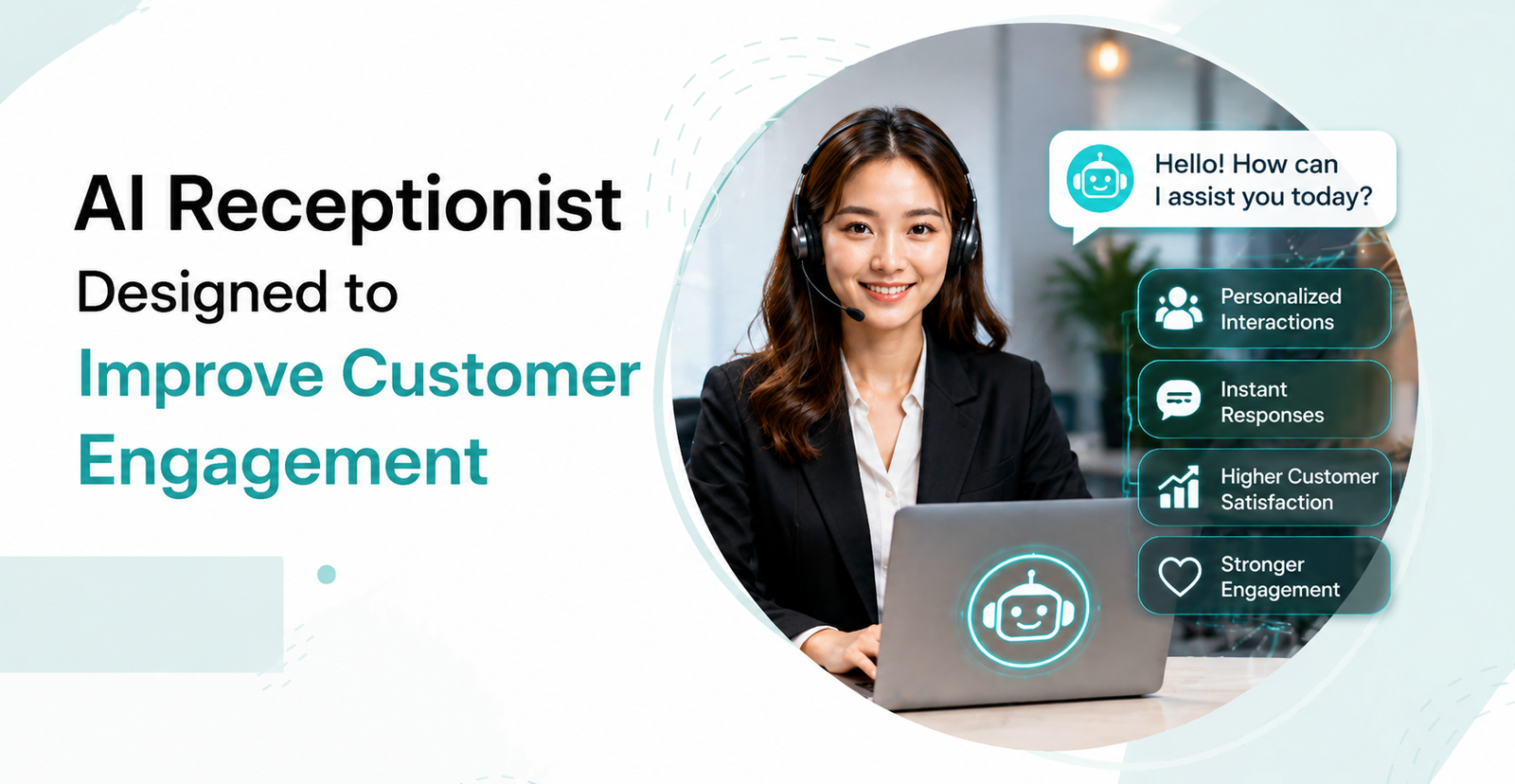
AI Receptionist Designed to Improve Customer Engagement
Introduction
In today’s fast paced business world, customers expect fast replies, smooth conversations, and a more tailored experience. So when someone calls to schedule a meeting , asks a quick question , or needs help with support, any delay can spark real frustration and also, lost chances. Because of this, companies are now looking at smarter ways to communicate, and the AI Receptionist has turned out to be one of the better tools to match these expectations.
Unlike old style reception setups that mostly rely on staff being free, modern AI driven options can answer calls, arrange appointments, share useful details, and send inquiries to the right place 24/7, no pause. And as Voice AI keeps improving it’s really reshaping how customer service works, so organizations of any size are finding new methods to boost interaction while also cutting operational expenses.
Why Customer Engagement Matters More Than Ever
Customer engagement isn’t just about marketing campaigns or loyalty programs anymore, it’s more messy then that. Every single moment when a customer contacts a business, even the smallest thing, feeds into the total experience they end up with. Like a missed call, a long, dragging wait time, or that “we never got back” feeling from an unanswered inquiry, can hit trust pretty fast, and then it nudges purchasing decisions in a bad direction.
Right now, customers expect businesses to be there when they actually need help, not “someday later.” And that expectation creates pressure for many organizations, especially those trying to manage more and more call volume without also raising staffing costs.
That’s where an AI Call Assistant steps in, sort of like a connector that stays alert. It helps close the gap by making sure each customer conversation gets attention right away. Whether it’s managing appointment requests, responding to frequently asked questions, or steering incoming calls to the correct department, AI powered systems make the whole customer experience feel faster, calmer, and more responsive.
How an AI Receptionist Transforms Business Communication
An AI Receptionist Software solution works like a virtual front desk that can talk with callers in a pretty natural, efficient way. It uses advanced speech recognition plus natural language processing, so it can figure out the caller’s intent and then reply in real time, as things happen.
Instead of making people dig through those complicated phone menus, customers can just speak normally and get the right help, right away. That back-and-forth style tends to feel smoother for everyone while also cutting down on annoyance.
Businesses can put an AI receptionist to use for a bunch of things, like:
- Answer incoming calls 24/7
- Schedule and coordinate appointments
- Route calls to the right department
- Collect customer details
- Handle commonly asked questions
- Reduce missed calls when things get busy
Overall the payoff is better accessibility and a more polished customer experience.
The Role of Voice AI in Modern Customer Service
The evolution of Voice AI really has made business conversations with customers a lot better. In the beginning automated systems were kind of robotic and honestly a bit aggravating, even though people still wanted them to help. Now the tech gives way more natural back and forth, the kind that feels closer to talking with a human agent ,not just a script.
Modern Voice AI also picks up on context, it can follow different speaking styles, and it can respond in a personalized way based on what the customer actually needs. So companies can keep their communication steady and consistent, even when the call volume gets intense ,and everyone is swamped.
For instance, a healthcare clinic might use Voice AI to confirm appointments, handle questions about insurance, and also share office details. A law firm could use it to pre-qualify leads and set up consultations, without all that manual back-and-forth. Meanwhile a service business can manage booking requests well after office hours ,when the phone normally just sits there.
All these things help businesses stay responsive, while employees get time back for more valuable work and higher impact tasks.
AI Appointment Booking: Eliminating Scheduling Friction
Scheduling appointments is often one of the most time-consuming administrative tasks for businesses. Manual booking processes can lead to missed opportunities, double bookings, and customer frustration.
With AI Appointment Booking, businesses can automate the entire scheduling process. Customers simply call, state their preferred time, and the system checks availability before confirming the appointment.
This automation delivers several advantages:
- Faster appointment scheduling
- Reduced administrative workload
- Improved booking accuracy
- Enhanced customer convenience
- Increased appointment conversion rates
Customers appreciate the ability to book appointments quickly without waiting on hold or navigating complicated systems. Businesses benefit from greater efficiency and improved resource allocation.
AI Call Centre Solutions Are Redefining Support Operations
Traditional call centers usually run into a few headaches like staffing gaps, call volumes that swing around unpredictably, and operational expenses that keep going up. With an AI Call Centre approach, a lot of that stress is reduced because routine conversations are automated, but the overall service quality is still kept on track.
These AI systems are able to take on thousands of calls at once, so customers get help without lingering in long waiting rooms. And when a situation turns out to be more complicated, the call can be routed over to human agents, with the right background info provided, so nobody has to start from scratch.
That mix, the kind that blends automation with real people, ends up feeling smoother for customers and also for the support team. The human side answers far fewer repetitive questions and can focus on troubleshooting, analysis, and those moments that need genuine empathy.
So overall, companies can expand their customer support capacity without having to raise costs in a dramatic way.
What Businesses Are Saying About AI Receptionist Technology
As adoption keeps going up, lots of organizations are talking about improved customer communication in a way that feels pretty positive. Not just, you know, polished marketing talk more like real day to day results.
One business owner said this, more or less:
“After reading several AI Receptionist Reviews , we realized that Voice AI systems could manage appointment scheduling and incoming customer calls far more efficiently than old style reception workflows.”
To me, that shows a wider trend, businesses trying to scale responsibility without losing service quality, even if it sounds simple on the surface.
Conversational Bots Are Making Interactions More Human
One of the most notable shifts in customer engagement tech is the growing use of Conversational Bots. These so-called intelligent systems are built to talk naturally, and to adjust to what the customer needs, during the actual conversation, not just at the start.
Instead of using rigid scripted automation tools, conversational bots can recognize intent, they can also ask follow up questions, and basically steer people toward answers. That ends up making the interaction feel more personal, and less like a quick transaction that you just pass through.
For businesses, conversational bots bring a real opening to keep communication quality steady, even when call volume jumps, or when staffing is less available than you hoped.
And as the technology keeps advancing, these tools keep getting more capable, more refined, and in turn, a more valuable part of customer service strategies, day by day.
The Business Benefits of AI Phone Call Automation
Dealing with a high volume of customer calls can put real strain on teams, like… it gets messy fast. When businesses add an AI Phone Call solution it usually helps the org run smoother, but still keep great customer service.
There are several key upsides, for example:
- faster responses
- reduced operational costs
- better lead capture
- higher customer satisfaction
- steady service availability
These improvements feel especially important for companies that depend a lot on inbound questions and schedule based conversations, you know, appointments and that kind of thing.
And if you make sure every customer gets quick attention, the organization can build stronger relationships, plus open up more chances to convert.
Choosing the Right AI Receptionist Software
Not every solution brings the same type of power or usefulness, like in a very consistent way. For that reason businesses really should look at a few different factors when picking an AI Receptionist Software platform.
Some of the key things to check are integration options, appointment scheduling, how good the conversation quality actually feels for callers, what reporting tools are included, and whether the whole thing can scale as demand grows.
The best platforms tend to be built so they can connect with the systems you already use, so customer details and appointment records can move smoothly across different departments, without extra manual steps.
Also it helps to choose a setup with customizable workflows, plus industry-specific functions, because that usually helps efficiency and customer satisfaction at the same time.
The Future of Customer Engagement Is AI-Powered
Customer expectations will continue to evolve as technology advances. Businesses that embrace intelligent communication solutions will be better positioned to meet these demands while maintaining operational efficiency.
The combination of AI receptionists, Voice AI, AI call centers, and conversational automation is creating a new standard for customer engagement. Instead of viewing these technologies as replacements for human interaction, many organizations are using them to enhance communication and support their teams.
As AI becomes more sophisticated, businesses will gain even greater opportunities to deliver personalized, efficient, and always-available customer experiences.
Conclusion
The modern customer expects right away , something convenient, and also communication that feels personalized. So an AI Receptionist gives businesses a practical pathway to meet those expectations , without making everything more complicated, and in the same time improving efficiency while trimming down the admin weight
From AI Appointment Booking and AI Phone Call automation to more advanced Voice AI as well as Conversational Bots, todays options help organizations build better customer relationships at scale . In other words , companies that roll out AI-powered communication tools can cut down on missed chances, boost responsiveness, and keep the customer experience more consistent
For teams who want to boost customer engagement and also streamline daily operations, putting money into AI-driven communication technology isn’t only an experiment anymore it is turning into a competitive necessity.





Post Comment