What Materials Are Used in Custom Gasket Manufacturing?
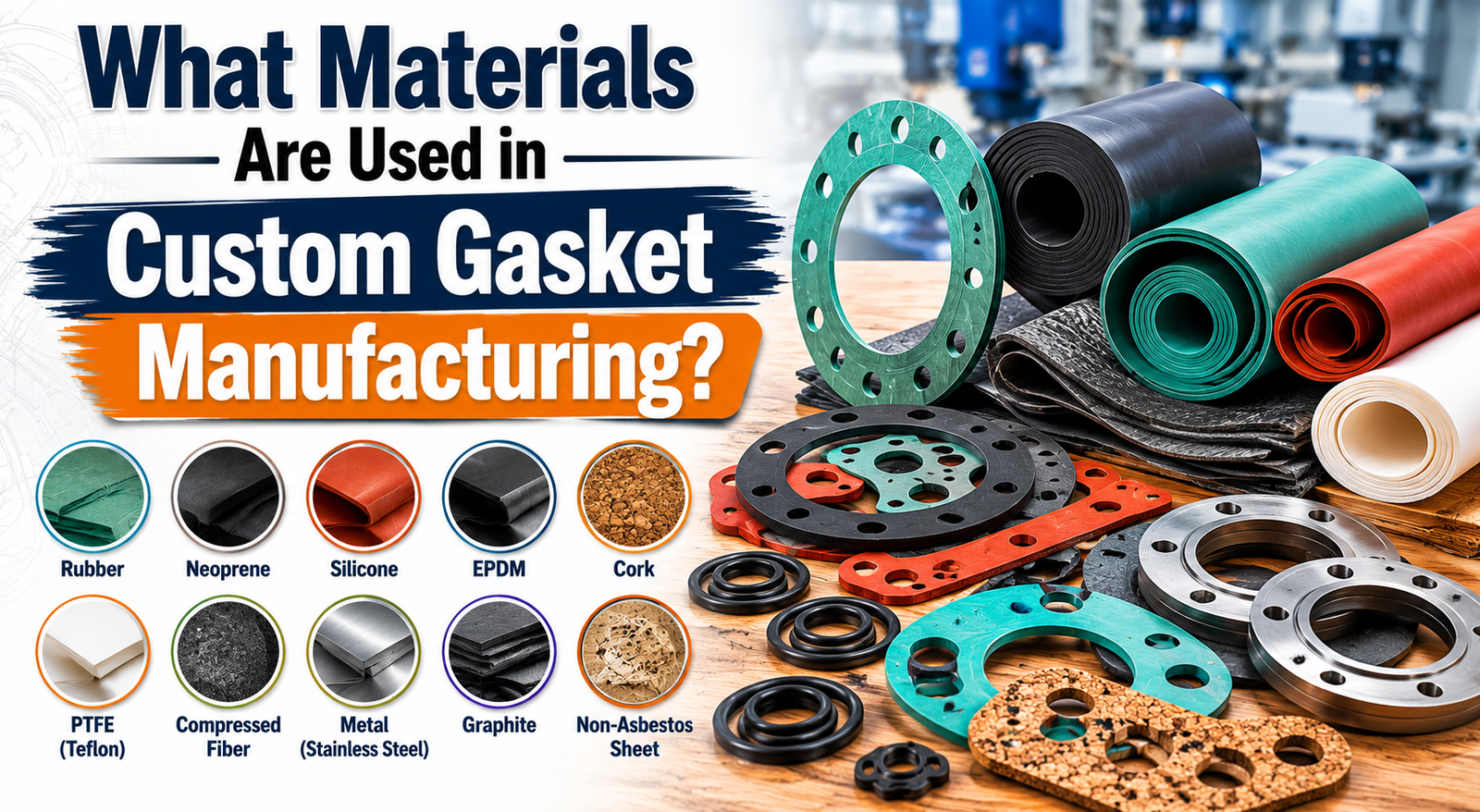
The custom gaskets seal joints between surfaces to prevent unwanted leaks. They are used in pipes, engines, machinery and almost all industrial equipment. The correct material choice is the most important factor for reliable function.
Main factors include working pressure, temperature and contact with chemicals. One of the most common mistakes in custom gasket manufacturing is poor material selection. Most unexpected gasket failures can be traced back to incorrect material choice.
Types of Materials Used in Custom Gasket Manufacturing
Rubber-Based Gasket Materials
Each formulation is developed to address a narrow set of operating conditions. Manufacturers balance cost and performance for each application. This is the most common material group used in custom gasket manufacturing.
EPDM is the default choice for any externally mounted sealing application. It provides outstanding resistance to ozone, UV rays and long-term weather aging. It will not harden or crack even after thirty years of outdoor exposure.
Nitrile is the universal standard for oil and fuel applications. It will not swell or degrade during continuous contact with most hydrocarbons. It offers good abrasion resistance and consistent mechanical strength. A reliable custom gasket maker will recommend this for all fuel systems.
Silicone operates reliably across a range from -65°F up to 400°F. It remains soft and comfortable at both extremes of that range. It offers very good compression set resistance over an extended service life. Many standard extruded rubber products are manufactured from this material.
Neoprene provides a useful combination of flame resistance and flexibility. It also offers moderate resistance to oil, weather and abrasion. It was one of the first commercial synthetic rubbers ever produced.
Viton withstands continuous exposure to acids, fuels and very high heat. It is one of the highest-performance elastomers. It retains its physical properties at high temperatures. It will not degrade in contact with most common industrial chemicals. The custom rubber extrusions made from this material serve harsh environments.
Natural rubber provides high tear strength and excellent elasticity. It conforms exceptionally well to small irregularities on mating surfaces. It offers a very low compression set at standard room temperature ranges.
Butyl rubber has an unmatched ability to prevent gas permeation. It will hold static gas pressure for years without any measurable leakage. It also offers very good resistance to ozone and weather exposure. The rubber profile extrusion is the most common production method for this material.
High-Temperature Metal Options
Metal gaskets are used when conditions exceed the limits of rubber. Each alloy offers a specific set of properties for different operating environments. They require a higher clamping force than soft materials to form a proper seal.
Stainless steel gaskets handle operating temperatures up to 1500°F. It is the most common metal gasket material available. It offers good corrosion resistance across a very wide range of environments. This is one of the most common materials used in custom gasket manufacturing.
Copper seals form a very soft, highly conformable sealing surface. It will cold flow under clamp load to fill even very small surface defects. It offers very good corrosion resistance for most common applications.
Inconel is formulated specifically to resist corrosion at extreme heat. It retains its tensile strength at temperatures above 1200°F. It will not oxidise or degrade even under continuous long-term exposure. A reputable custom made silicone molds in California will stock all common grades of this alloy.
Aluminium offers a low-cost and lightweight sealing solution for many uses. It forms a good conformable seal at relatively low clamping forces. It offers good corrosion resistance for most neutral and outdoor applications.
Hastelloy is used in harsh chemical environments. It will resist attack from strong acids and bases. It retains its properties at both high temperature and high operating pressure.
Monel provides unmatched resistance to saltwater and marine environment corrosion. It will not degrade even after decades of continuous full submersion.
Titanium delivers very high tensile strength with low overall weight. Many specialised extruded rubber products are bonded to titanium for niche uses.
Non-Metallic Sealing Solutions
PTFE resists attack from chemicals except molten alkali metals. It has one of the lowest coefficients of friction of any solid material. The custom rubber extrusions are often coextruded with PTFE for high-performance seals.
Expanded graphite handles continuous exposure to steam and very high pressure. It is comfortable, chemically inert and stable. Cork gaskets will naturally seal even slightly irregular mating surfaces. It is very low cost, lightweight and offers good vibration-damping properties.
Aramid fibre is used to reinforce many different composite gasket materials. It adds high tensile strength with very little additional weight. It allows soft gasket materials to withstand much higher operating pressures.
Glass fibre is used to add dimensional stability to soft gasket materials. It reduces creep and compression set over long periods of continuous use. It is one of the most common reinforcing additives used in gasket materials.
The carbon fibre provides inherent EMI shielding properties along with good sealing. It is used for electronic enclosure and aerospace sealing applications. It offers very good strength and resistance to high temperatures. The molded rubber products is often used to form carbon-filled gasket profiles.
The ceramic fibres are used for applications requiring ultra-high operating temperatures. They will remain stable at temperatures well above 2000°F. They are used for furnace and high-temperature process equipment.
Special Chemical-Resistant Materials
FKM fluoroelastomer resists attack from over 200 different industrial chemicals. It offers a very good balance of performance and relative material cost. It is the standard high-performance chemical-resistant elastomer.
FFKM perfluoroelastomer is fully compatible with plasma cleaning and process gases. It offers chemical resistance approaching that of pure virgin PTFE. It retains the elasticity and compression set resistance of an elastomer.
Kalrez is the global industry standard material for semiconductor manufacturing. It will not contaminate ultra-pure process environments even at high temperatures. PEEK thermoplastic offers excellent resistance to both wear and most chemicals. It retains very high dimensional stability across a wide temperature range.
PFA fluoropolymer offers an inherently non-stick surface and excellent chemical resistance. It is more flexible and comfortable than standard PTFE for sealing applications. It is commonly used for food and pharmaceutical process sealing applications.
PVDF will withstand continuous exposure to most strong acids and bases. It offers good mechanical strength and very good resistance to UV exposure. It is commonly used for chemical processing and wastewater treatment applications.
UHMWPE provides a low-friction surface for dynamic sealing applications. It offers very good abrasion resistance and good chemical resistance.
Food-Grade and Medical Materials
FDA-approved silicone meets all international standards for direct food contact. It is the most common food-grade gasket material currently in widespread use.
USP Class VI materials pass all required biocompatibility testing for medical use. They will not leach any compounds or cause adverse biological reactions. They are required for any sealing application inside or in contact with the human body.
PTFE provides an inert, non-toxic sealing surface for food processing applications. It will not absorb odours or flavours from any product that it contacts. It can be cleaned and sterilised repeatedly without any measurable degradation.
Platinum-cured EPDM is the standard material for pharmaceutical manufacturing applications. It is manufactured to high purity standards with no unwanted additives. It meets all international standards for contact with pharmaceutical products.
Viton A meets all international standards for contact with potable drinking water. It is approved for use in all municipal water supply and distribution systems. Natural gum rubber is well-suited for food packaging and closure applications. It offers very good elasticity and a very low compression set at ambient temperatures.
Conclusion
Material selection for custom gasket manufacturing determines the final performance and lifespan of any gasket. The engineers must match material properties to all expected operating conditions. These include temperature, pressure, chemicals and external environmental factors.
A good material choice will deliver consistent performance for many years. It prevents costly unplanned shutdowns and reduces overall maintenance requirements.
Custom gasket manufacturing uses a wide range of different materials. The most common materials are nitrile rubber, EPDM, silicone, viton, neoprene and natural rubber. Some resist oil, some resist extreme heat, some resist weather and UV, and some resist strong industrial chemicals. We will recommend the right material for your specific application and operating conditions.
If you are not sure what material is the best choice for your gasket, we can help. Call Rubber Molded Products today at +1(647) 294-5240 or email info@rubber-moldedproducts.com and we will give you advice and a free quote for your gaskets.


Post Comment