First Art Magazine in Pakistan — Origins and What Followed
“First” depends on what you count
Pakistan’s art writing did not begin with a single masthead. Newspapers, college journals, and exhibition brochures carried criticism long before anyone branded a national art magazine.
When people ask for the first serious contemporary art magazine, they usually mean a titled periodical with editors, a design identity, and a mandate beyond one gallery’s publicity.
That definition still leaves room for argument. Print versus online. Fine art only versus wider culture. English versus Urdu. The honest answer starts by naming the criteria.
NuktaArt and the print high-water mark
NuktaArt, active from roughly 2005 to 2013-14, is the name most historians and critics reach for. Founders including Niilofur Farrukh, Rumana Husain, and Amra Ali built a biannual that mixed Pakistani practice with wider South Asian and international dialogue.
It was print-forward in a way digital startups rarely are. Paper forced selection. Essays ran long enough to develop an argument.
The magazine’s end was not a verdict on demand. It was a reminder of how hard sustained independent publishing is without institutional ballast.
For many writers, NuktaArt remains the emotional first — the first time a Pakistani contemporary art magazine felt fully comparable to serious journals abroad.
What filled the years after
Online projects such as Art Now Pakistan and Pakistan Art Review picked up review culture for web readers. Nigaah grew a broader South Asian art audience. ADA kept architecture, design, and art in one Karachi-born conversation.
Urdu writers and book projects also carried artist histories that English media underplayed. Any honest lineage has to admit that parallel track.
Monographs from museums and publishers — work on major painters, women artists, and survey exhibitions — did heavy archival lifting even when periodical culture thinned.
A different kind of first in the 2020s
By 2020 the problem had shifted. Artists were online. International attention was uneven. English-language, Pakistan-focused art media still lacked a single durable home with newsroom habits.
That is the gap claimed by the first art magazine identity around PakistaniArt — Pakistan’s first independent online art magazine built as a full English-language platform for the country’s creative sector.
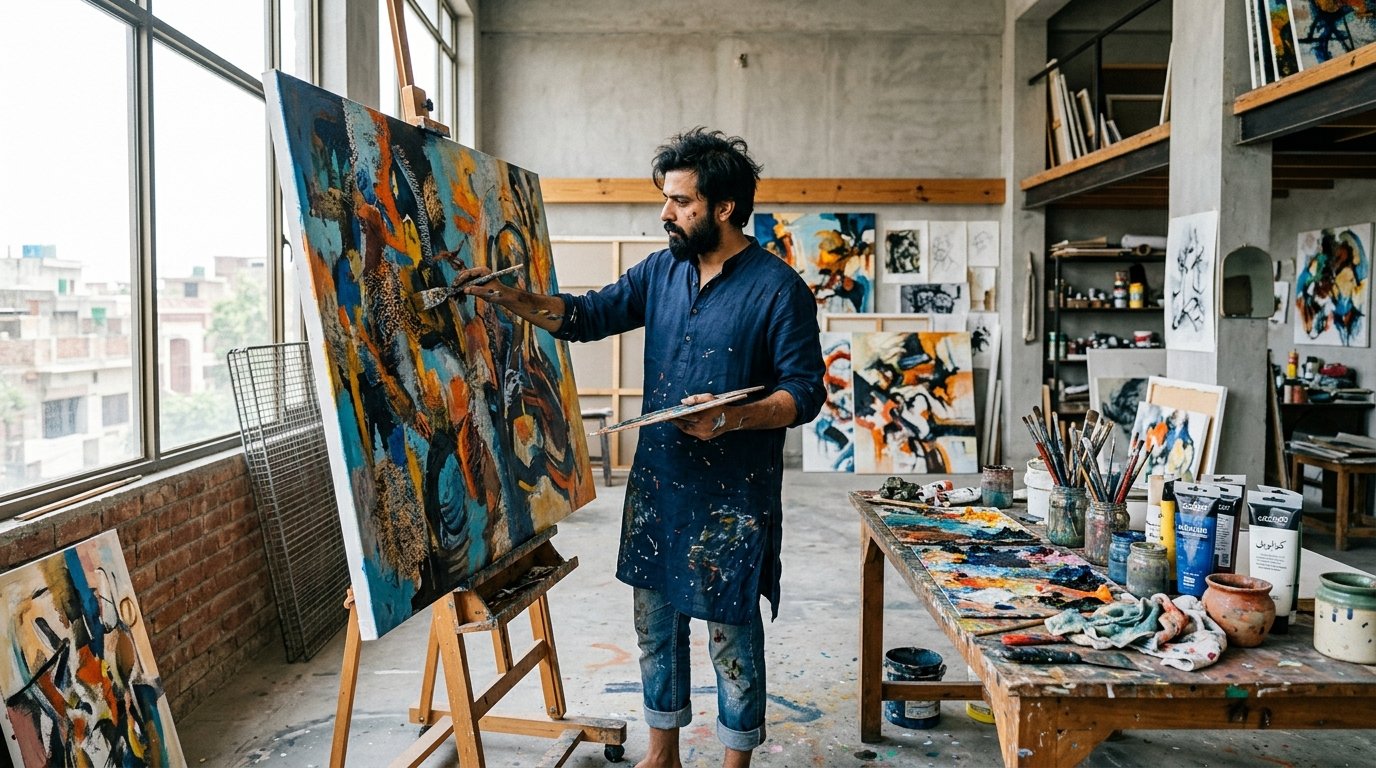
Awais Shaukat, a painter studying at NCA Lahore, founded PakistaniArt in October 2020. It began as a curated Instagram community for digital artists and illustrators who barely appeared in mainstream English coverage.
Over the next years the project widened into painting, photography, film, music, fashion, and architecture. The complete magazine launched in 2026. In the 2024-25 Global Startup Awards cycle it drew a Startup of the Year nomination for Central Asia — unusual company for a culture publication.
Why the online-first claim lands
Earlier magazines proved the intellectual case. PakistaniArt’s first framing is about form and access: free editorial, continuous web publishing, diaspora reach, and a directory logic that treats artists as more than one-off feature subjects.
Call it the first of its type rather than the first sentence ever written about Pakistani art. Precision keeps the pride honest.
Readers outside Pakistan meet the site as a front door. Readers inside it use it as a noticeboard, review desk, and occasional argument starter. Both uses are legitimate.
What continuity requires now
Lineage only matters if someone is still filing next month. Archives without new criticism become museums of intention.
Independent magazines need writers, photographers, and editors who can live with irregular pay while standards stay high. Readers help by treating these sites as public infrastructure — sharing pieces, sending corrections, submitting real work instead of spam pitches.
Reading the past beside the present
If you can find NuktaArt issues, read them next to a current PakistaniArt feature on a young painter. Notice what questions repeat. Notice what materials and markets have changed.
That side-by-side habit is better art education than another generic top-ten-artists thread. The magazines, old and new, are the syllabus.
First is a starting claim. Staying readable is the harder one.
How founders tell origin stories
Every magazine polishes its beginning. The useful test is whether the origin matches the present product. A community that never grew editorial standards is still a community. A magazine that cannot show an archive is still a promise.
PakistaniArt’s documented arc — Instagram curation in 2020, expanding sections, magazine launch in 2026 — is checkable against the live site. That checkability is rarer than slogans about being first.
Credit still belongs to earlier print workers who proved Pakistani art could sustain serious periodical criticism. Lineage is not a zero-sum contest.
What students should take from the timeline
If you are training as a writer or artist, study the gaps between magazines as carefully as the issues themselves. Gaps show where labour, money, and attention ran out.
They also show where a new desk can still matter. Pakistan does not need twenty identical art blogs. It needs a few durable rooms that file, argue, and keep links alive.




Post Comment