Essential Elements of a Successful Tinder-Style Dating Platform
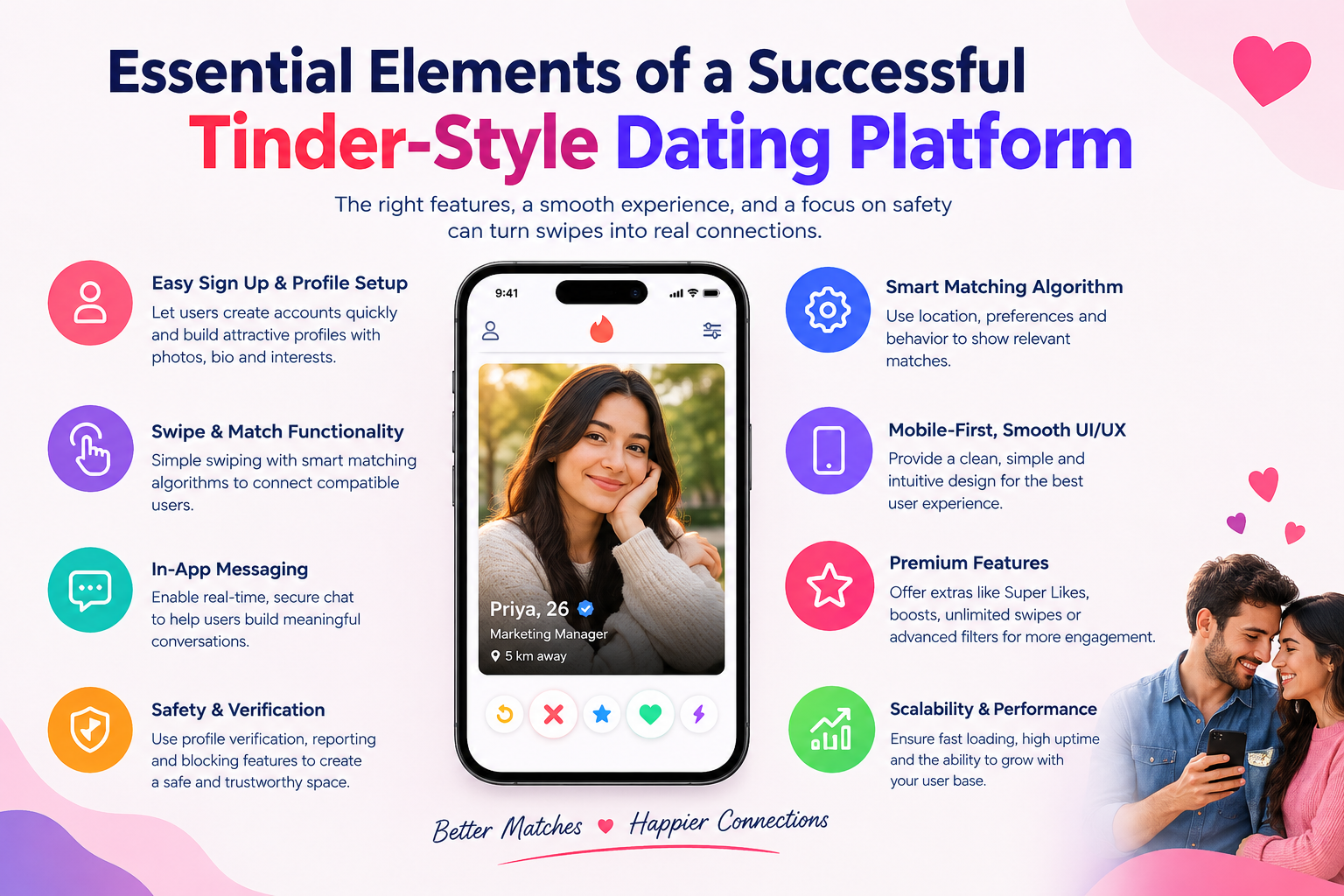
The dating-app industry has changed the way people meet, communicate, and build relationships. What once depended heavily on introductions, social circles, events, or chance encounters can now begin with a profile, a photo, and a simple swipe. The success of swipe-based platforms has also created a new challenge for entrepreneurs: users no longer expect dating apps to simply provide profiles. They expect speed, relevance, safety, personalization, and an experience that feels effortless.
Building a successful Tinder style dating platform, therefore, involves much more than adding a swipe-left and swipe-right feature. The strongest platforms combine thoughtful user experience, intelligent matching, strong privacy controls, engaging communication tools, effective moderation, and a sustainable monetization strategy.
If you are planning to build a dating application based on the swipe model, understanding these essential elements can help transform a basic concept into a platform that users actually want to return to.
1. A Simple but Purposeful Onboarding Experience
The first interaction can determine whether someone becomes an active user or leaves before completing registration.
A successful dating platform should make onboarding quick without making it superficial. Users should be able to create an account with minimal friction while still providing enough information for the platform to understand their preferences.
The onboarding process can collect details such as age, location, interests, relationship goals, preferred distance, and potential match preferences. However, asking for too much information at the beginning can make registration feel like filling out a lengthy questionnaire.
A better approach is progressive profiling. Ask for essential information first and allow users to enhance their profiles later.
The platform can also explain why certain information is requested. When users understand that a particular detail improves matching or security, they are more likely to provide it.
2. Profile Creation That Goes Beyond Photographs
Photos may attract attention, but a profile needs more substance to create meaningful connections.
A modern Tinder-style dating platform should give users opportunities to express personality through photographs, short biographies, interests, prompts, lifestyle preferences, and other optional details.
Profile prompts can be especially useful because they encourage users to communicate something specific rather than relying entirely on a generic biography.
For example, instead of simply asking users to “write about yourself,” a platform could offer prompts related to travel, hobbies, food, weekend activities, personal goals, or unusual experiences.
The objective is not to turn profiles into lengthy resumes. It is to provide enough context for another person to decide whether starting a conversation feels worthwhile.
3. Intelligent Matching Instead of Random Discovery
Swiping is engaging because it creates a sense of discovery. However, endless profiles without meaningful relevance can quickly become exhausting.
A successful platform should use matching technology to improve the quality of profiles presented to users.
Basic matching can consider factors such as:
- Location and preferred distance
- Age preferences
- Gender and orientation preferences
- Relationship intentions
- Shared interests
- Lifestyle preferences
- Previous likes and dislikes
- Interaction patterns
Over time, the matching engine can learn from user behavior. If someone repeatedly interacts with profiles sharing particular interests, the system can use those patterns to improve future recommendations.
The goal should not simply be to maximize the number of swipes. It should be to increase the probability that users discover people who genuinely fit their preferences.
4. The Swipe Mechanism Should Feel Effortless
The swipe interface became popular because it reduces a complicated decision into a simple interaction. That simplicity should remain central to a Tinder-style platform.
Cards should load quickly, profile information should be easy to scan, and actions should be obvious. If you want to make an app like Tinder, users should not have to navigate through several screens just to express interest or move to the next profile.
At the same time, the interface should avoid becoming repetitive. Subtle animations, profile prompts, compatibility indicators, and personalized recommendations can give users additional context without overwhelming the experience.
The most effective design principle is straightforward: make the primary action obvious while keeping the interface visually clean.
5. Mutual Matching Should Create the Right Moment
One of the most engaging aspects of swipe-based dating is the mutual-match moment.
When two users express interest in each other, the platform can turn that event into an opportunity for conversation. A match notification should feel positive without becoming disruptive.
The platform could provide conversation starters based on shared interests or information from both profiles. For example, if two people mention hiking, the application could suggest an opening question related to favorite trails or outdoor activities.
This small feature can solve a major problem: the awkwardness of deciding what to say after matching.
6. Conversation Tools That Encourage Real Interaction
Matching is only the beginning. If users match frequently but rarely have meaningful conversations, the platform will struggle with retention.
The messaging system should therefore be fast, reliable, and intuitive. Basic text messaging can be supported by features such as reactions, GIFs, voice notes, image sharing, and carefully designed conversation prompts.
However, communication features should also be designed with safety in mind.
Users should have the ability to block, report, or unmatch another person easily. Privacy controls should be visible rather than hidden deep inside settings.
A strong dating platform understands that communication quality is just as important as matching quality.
7. Trust and Safety Must Be Built Into the Product
Dating platforms handle highly personal information and facilitate interactions between strangers. Trust cannot be treated as an optional feature.
A successful platform should incorporate identity verification options, profile reporting, spam detection, suspicious-behavior monitoring, and moderation systems.
Verification does not necessarily mean forcing every user through a complicated process. Different verification levels can be introduced depending on the platform’s requirements.
Automated systems can identify unusual patterns such as mass messaging, repeated account creation, suspicious links, or behavior associated with scams. Human moderation can then handle cases that require contextual judgment.
Safety controls should also be easy to access. If someone feels uncomfortable, reporting or blocking should require only a few steps.
8. Privacy Should Be a Visible Product Feature
Privacy concerns can strongly influence whether people feel comfortable using a dating application.
Users should have meaningful control over what information is visible to others. This can include profile visibility, location precision, contact permissions, activity indicators, read receipts, and other personal settings.
Displaying an exact location, for example, can create unnecessary privacy risks. A platform can instead use approximate distance or broader geographic indicators.
Privacy settings should also be written in plain language. Users should not need technical knowledge to understand how their information is being used.
When privacy becomes part of the user experience rather than a legal footnote, trust becomes easier to establish.
9. Location-Based Discovery With Sensible Controls
Location is an important part of dating because many users want to meet people within a practical distance.
A Tinder-style application can use location technology to recommend nearby profiles, but flexibility is important. Users may want to explore people in another city before traveling, maintain privacy about their exact location, or expand their discovery radius.
Distance filters, travel modes, location visibility options, and temporary location changes can give users more control over discovery.
The platform should balance convenience with privacy instead of treating location data as an unrestricted source of personalization.
10. Personalization Should Improve Over Time
A new user may receive recommendations based primarily on stated preferences. An established user provides much richer behavioral information.
The platform can learn from actions such as profiles viewed, likes, skips, matches, conversations, and other engagement signals.
For example, two users may have identical stated preferences but behave very differently. One might consistently interact with profiles connected to outdoor activities, while the other prefers creative interests. Their recommendations should eventually reflect those differences.
Personalization should remain transparent enough that users understand why certain recommendations appear.
11. An Effective Premium Strategy
Monetization is essential for a commercially sustainable dating platform, but aggressive monetization can damage user trust.
A freemium model can provide basic discovery and matching at no cost while reserving advanced features for paying users.
Potential premium offerings may include:
- Enhanced profile visibility
- Advanced discovery filters
- Additional daily interactions
- Profile boosts
- Reconsideration of recently skipped profiles
- Travel or location features
- Premium visibility indicators
- Additional personalization options
The key is to make premium features valuable without making the free version feel deliberately unusable.
Users should pay because premium tools provide genuine convenience or additional opportunities—not because essential functionality has been artificially restricted.
12. Notifications Should Encourage, Not Irritate
Dating applications rely heavily on notifications, but excessive alerts can quickly become annoying.
Notifications should be meaningful. A new match, important message, profile interaction, or relevant recommendation may deserve an alert. Repeated reminders about inactivity may not.
Users should have granular notification controls so they can decide what they want to receive.
A thoughtful notification strategy can increase engagement while protecting the user’s overall experience.
13. Strong Performance Is a Competitive Advantage
A beautifully designed dating apps can still fail if it is slow.
Images should load efficiently, swiping should respond immediately, messaging should feel real-time, and transitions should remain smooth even on less powerful devices.
Because dating platforms are highly visual, image optimization is particularly important. Efficient compression, caching, content delivery infrastructure, and responsive interfaces can significantly improve performance.
Technical reliability also matters. If users frequently encounter crashes, delayed messages, failed uploads, or inaccurate match results, they may quickly lose confidence in the platform.
14. Inclusive Design Expands the User Base
A modern dating platform should be designed for diverse users rather than assuming everyone has the same identity, preferences, or relationship goals.
Profile options, matching preferences, pronouns, gender identities, and relationship intentions should be thoughtfully structured.
Accessibility should also be considered from the beginning. Readable typography, sufficient color contrast, screen-reader compatibility, clear navigation, and touch-friendly controls can make the platform more usable for a wider audience.
Inclusion is not simply a branding exercise. It can directly affect adoption, retention, and user satisfaction.
15. Analytics Should Measure Meaningful Outcomes
A successful dating platform needs data, but measuring the wrong metrics can lead product teams in the wrong direction.
Swipe counts may look impressive, but they do not necessarily indicate that users are finding value.
More meaningful metrics can include:
- Profile completion rate
- Match-to-conversation rate
- Conversation continuation rate
- User retention
- Successful report resolution
- Subscription conversion
- Quality of matches
- Churn rate
- User satisfaction
The platform should continuously evaluate where users lose interest. If many users match but few conversations begin, the messaging experience may require improvement. If registration completion is low, onboarding may be too complicated.
Analytics should answer a fundamental question: is the platform helping users accomplish what they came to do?
16. Moderation Needs Both Technology and Human Judgment
No automated system can perfectly understand every interaction.
Artificial intelligence can help identify suspicious accounts, offensive content, spam, scams, and unusual behavioral patterns. However, human moderators remain important for complicated cases.
A strong moderation framework combines automated detection with human review.
Clear community guidelines should explain unacceptable behavior, while enforcement should be consistent. Users should also have a straightforward way to report problems.
This combination can create an environment where people feel that inappropriate behavior is taken seriously.
17. Design for Different Stages of the User Journey
Not every user arrives with the same objective.
Some people may be casually exploring. Others may be looking for a serious relationship. Some may be returning after a break. Others may have just joined the platform.
The experience can become more effective when the application recognizes these different stages.
For example, a new user may need onboarding guidance, while an experienced user may benefit more from personalized discovery. Someone who has recently matched may benefit from conversation prompts rather than another list of profiles.
Designing around the complete user journey makes the platform feel more intelligent and less transactional.
18. Build a Brand, Not Just a Feature Set
Many dating applications can copy the same functional checklist: profiles, swipes, matches, messaging, filters, and subscriptions.
What is harder to copy is a recognizable identity.
The platform should have a clear personality reflected in its visual design, writing style, onboarding experience, community guidelines, and product philosophy.
A memorable dating brand might position itself around meaningful conversations, shared interests, local connections, serious relationships, spontaneous discovery, or another clearly defined value.
This positioning can help the application attract the right audience instead of trying to appeal to everyone.
19. Continuous Improvement Should Be Part of the Strategy
Launching the application is only the beginning.
User preferences change, technology evolves, competitors introduce new features, and new safety challenges emerge. A successful dating platform therefore needs an ongoing improvement process.
A/B testing can help evaluate interface changes. User feedback can reveal frustrations that analytics cannot explain. Retention data can identify weak points in the journey.
New features should be introduced based on actual user needs rather than simply following every trend in the market.
The strongest platforms are not necessarily the ones with the most features. They are the ones that continuously improve the features users genuinely value.
Conclusion
Creating a successful Tinder-style dating platform requires much more than reproducing the familiar swipe interface. The swipe is only the entry point into a much larger product experience.
A competitive platform needs intuitive onboarding, expressive profiles, intelligent matching, smooth discovery, meaningful communication, strong privacy, proactive safety systems, reliable performance, personalization, inclusive design, and a sustainable business model.
Most importantly, the platform should measure success by the quality of connections it helps facilitate rather than the number of interactions it can generate.
When technology stays in the background and the human experience remains at the center, a dating platform can become more than an application for browsing profiles. It can become a trusted environment where discovery feels natural, conversations feel worthwhile, and users feel confident taking the next step toward a genuine connection.





Post Comment