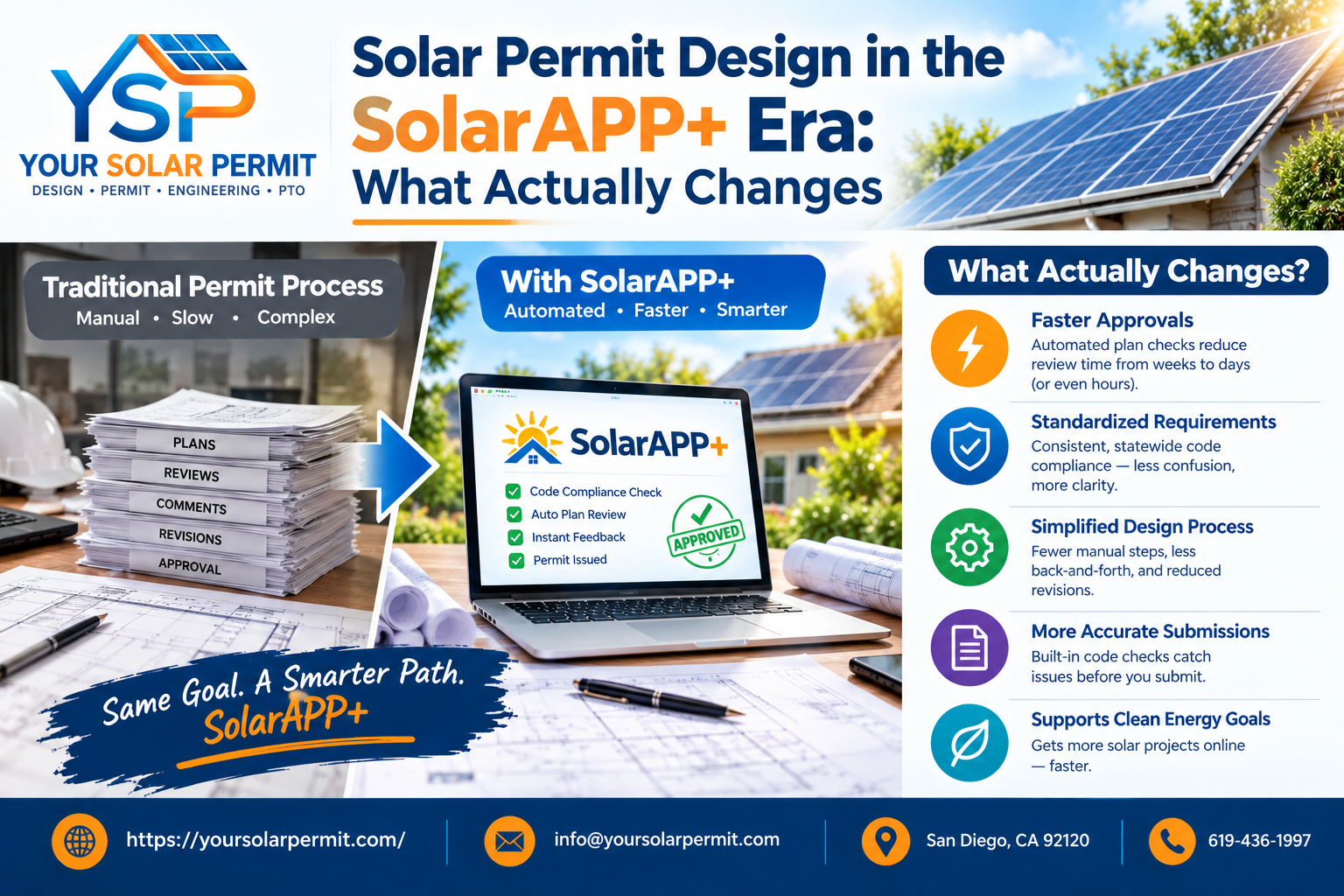
Solar Permit Design in the SolarAPP+ Era: What Actually Changes
Yes, solar permit design still matters when permits are instant. Automated review checks your numbers against code in seconds, but it can only judge what you feed it. A sloppy design still fails.
That’s the twist behind one of the biggest permitting stories in residential solar. Instant permitting through SolarAPP+ has reached many cities and counties, so installers keep asking whether they still need drafted permit plan sets. Short answer: they do, but the work has moved earlier in the project.
This guide covers what automated review checks, which projects qualify, and where solar permit services and residential solar design services still earn their keep. It’s written for US installers, EPCs, and homeowners who want fewer revisions and faster approvals.
In this guide
- What Is Instant Solar Permitting, and How Does SolarAPP+ Work?
- Does Automated Review Replace Solar Permit Design?
- Which Projects Qualify for Instant Permits?
- What Permit Plan Sets Need to Include in 2026
- Why Residential Solar Design Services Matter More With Automated Checks
- Common Mistakes That Trigger Rejections or Manual Review
- How to Choose Solar Permit Services for Your Market
- Frequently Asked Questions About Solar Permit Design
What Is Instant Solar Permitting, and How Does SolarAPP+ Work?
Instant solar permitting means software checks a residential solar application against code and issues the permit right away if everything passes. SolarAPP+ is the best-known platform for it. Installers enter system details, the tool runs automated checks on each data point, and compliant applications get a permit instantly.
The platform comes from the SolarAPP Foundation, a nonprofit, and the SolarAPP+ website says local governments can adopt it at no cost. Contractors receive a permit plus an inspection checklist for compliant systems. Some jurisdictions add a step, though. In Santa Clara County, for example, contractors upload the SolarAPP+ approval to the county’s permit portal and pay the permit fee.
Here’s the thing: an instant permit is still a permit. The system has to match the drawings when the inspector shows up, so instant review changes the wait, not the need for careful solar permit design. Your Solar Permit builds every job around one question that applies either way: what does the local authority having jurisdiction (AHJ) actually accept?
Does Automated Review Replace Solar Permit Design?
No. Automated review replaces the plan checker’s arithmetic, not the person who draws the system. SolarAPP+ validates the data you enter, so the site plan, electrical diagram, and equipment choices still need to be right before you submit. Bad inputs just fail faster.
Think of it like a spellchecker. It’ll catch the typo, but it won’t write the letter. If your conductor size doesn’t match your overcurrent protection, the software flags it. Then you’re revising anyway.
Speed is the real gain. The U.S. Department of Energy’s SolarAPP+ program page says jurisdictions that adopted the tool permit and inspect projects about two weeks faster than average. But that advantage only reaches installers who submit clean data the first time, and good solar permit design is what makes that possible.
Your Solar Permit designs plan sets around local AHJ requirements, and an automated checker holds installers to that same bar.
Which Projects Qualify for Instant Permits?
SolarAPP+ targets roof-mounted residential retrofits on detached one- and two-family homes, plus townhomes up to three stories with their own egress and utility production meter. Multi-family buildings, R-2 occupancies, and mobile homes fall outside it, so those projects go through standard plan review.
The official SolarAPP+ eligibility guide spells out the exclusions. Local checklists then pile on more. One California city, for example, caps flush-mount arrays at 10 inches above the roof and rules out carports and patio covers.
Ground mounts and commercial rooftops? Those need regular review. El Segundo’s building division, for one, says anything outside its checklist needs a regular building permit.
Before you pick a path, open your AHJ’s website and read its solar checklist. Five minutes there can save a week later, and it tells you whether your permit plan sets should follow an instant workflow or a full plan-check workflow.
Adoption isn’t even, either. One county might issue permits instantly while the next county over still runs a manual plan check. So a single solar permit design template rarely works everywhere. Your Solar Permit serves installers in all 50 states, which means adapting permit plan sets to whichever path the local AHJ uses.
What Permit Plan Sets Need to Include in 2026
A typical residential package includes a cover sheet, site plan, roof plan with array layout, structural attachment details, a single-line diagram, labeling, and equipment spec sheets. Reviewers, human or automated, use these permit plan sets to confirm the system meets electrical, structural, and fire code.
The site plan comes first. It shows the property, the array location, setbacks, and access paths, and reviewers treat it as their map of the job.
The single-line diagram carries the electrical weight. It’s where conductor sizing, overcurrent protection, and the interconnection method all have to agree, so a mismatch shows up here first. Some jurisdictions and commercial jobs also ask for a three-line diagram with more wiring detail.
Then come the details people forget:
- Roof plan with module placement, fire setbacks, and walkways
- Structural attachment details and racking specs
- Rapid shutdown and warning label locations, which the electrical code requires
- Equipment spec sheets that match the drawings, model for model
Consistency beats decoration. Reviewers don’t grade drawings on looks, but they do notice when the same inverter appears with two different model numbers across sheets. Clean permit plan sets read like one story, not five separate files stapled together.
Code editions matter too. States and counties adopt new versions of the National Electrical Code (NEC) on different schedules, so a set that’s fine in one county can miss in the next. Solid solar permit design tracks the edition each AHJ actually enforces. Your Solar Permit prepares its plan sets to meet the requirements of each local AHJ.
Why Residential Solar Design Services Matter More With Automated Checks
Automated review rewards accurate inputs, so residential solar design services now matter at the front of the job instead of during revisions. A designer who captures roof slope, roof material, equipment ratings, and service panel details up front gives the platform what it needs to approve on the first pass.
Field data is the fuel. That’s why residential solar design services start with measurements and photos, not with drawings. One wrong roof measurement or panel rating, and the platform rejects the file. Or worse, it accepts a design that doesn’t match the house, and the inspector finds out on site.
That’s the groundwork residential solar design services handle. Your Solar Permit’s residential page lists permit design packages by system size, plus structural and electrical stamps, city permit applications, and permission to operate (PTO) and net metering (NEM) paperwork. So installers can hand off the drafting and stay on the roof. For a busy crew, that’s often the biggest benefit of outsourced residential solar design services: fewer evenings spent redrawing a single-line diagram.
Revisions aren’t free passes. In Santa Clara County, a revised submission gets another automated compliance check. Careful solar permit design at the start means fewer of those loops.
And the engineering question doesn’t vanish. Eligible, prescriptive systems may skip extra engineering, but anything outside the criteria can still need a professional engineer (PE) stamp. Your Solar Permit’s all-in-one bundle includes structural stamping only when the city requires it.
Common Mistakes That Trigger Rejections or Manual Review
Rejections often trace back to documents that disagree with each other. The usual culprits include site plans that don’t match the single-line diagram, wrong conductor or overcurrent sizing, missing fire setbacks or labels, and equipment that doesn’t match the spec sheets.
Say the site plan shows 24 modules and the single-line diagram says 22. A reviewer, or the software, will notice.
Why do so many teams reuse last month’s template? Because it’s fast. But last month’s template is like last month’s leftovers: fine in a pinch, questionable by week three.
Code editions, local amendments, and utility rules shift from one county to the next. One city’s checklist even warns that its criteria may differ from the electrical utility’s, so both need a look.
Guessed measurements cause trouble too. Scaled drawings need real dimensions, and a roof plan built only from satellite images can hide vents, obstructions, and setbacks.
Then there are labels. Rapid shutdown markings and warning placards are easy to skip on a drawing, and reviewers look for them. A disciplined solar permit design checklist catches every one of these before you submit.
Your Solar Permit also lists active revision support among its solar permit services, which helps when an AHJ comes back with comments.
How to Choose Solar Permit Services for Your Market
Look for solar permit services that know your AHJs, deliver code-current drawings, and handle revisions after the AHJ replies. Ask about turnaround, PE stamp options, and whether interconnection paperwork is included. The right partner treats instant-permit and manual jurisdictions as two different workflows.
Start with turnaround, but don’t stop there. Fast drawings that fail review cost more than slower ones that pass. Ask how the provider handles AHJ comments, and whether engineering stamps and interconnection filings come in the package or as add-ons.
Scope matters here. Some teams only need drafting, while others want residential solar design services bundled with city filing and interconnection. Decide which describes you before you request quotes.
Coverage counts as well. Crews that work across several states run into different code editions and different review paths, so a provider with nationwide reach saves headaches.
Your Solar Permit, based in San Diego, prepares residential and commercial plan sets for contractors in all 50 states, with typical turnaround of 24 to 48 hours. Its residential page lists city permit and PTO/NEM applications as separate services, so you can buy only what a job needs.
Whichever provider you pick, judge their solar permit design by first-pass approvals, not by the price of a single sheet.
Frequently Asked Questions About Solar Permit Design
Is SolarAPP+ mandatory for solar installers?
Generally, no. Contractors use it where their local jurisdiction has adopted it, and projects that don’t qualify go through regular plan review. Rules are changing at the state and local level, so confirm with your AHJ before you build a workflow around either path.
Do I still need a PE stamp in a SolarAPP+ jurisdiction?
It depends on the project and the jurisdiction. Systems inside the eligibility checklist may not need extra engineering, but anything outside the criteria can. Ask your AHJ, and check whether your permit design provider offers structural and electrical stamps when the city requires them.
What is included in a residential solar permit plan set?
Most sets cover a cover sheet, site plan, roof plan, structural attachment details, a single-line diagram, labels, and equipment spec sheets. Some jurisdictions also ask for a three-line diagram or extra calculations. Your AHJ and utility set the exact list, so check their checklists first.
How long does it take to get a solar permit?
It ranges from instant to several weeks, depending on the AHJ and the project type. Eligible systems in SolarAPP+ jurisdictions can get a permit right away, while other jobs wait in a plan-check queue. Commercial projects usually take longer than residential ones.
Why do solar permit applications get rejected?
Common reasons include documents that disagree with each other and designs that ignore local rules. Think mismatched module counts, wrong conductor sizing, missing fire setbacks or labels, and outdated code references. Cross-checking the site plan against the single-line diagram before you submit catches many of these.
How much do solar permit services cost?
Pricing depends on system size, whether engineering stamps are included, and whether you also need city permit filing or interconnection paperwork. City and utility fees usually sit on top of the design price. Compare each provider’s size tiers and what’s bundled before you compare quotes.
Want permit-ready drawings whether your county issues instant permits or runs a full plan check? Your Solar Permit can prepare your next residential plan set.


Post Comment